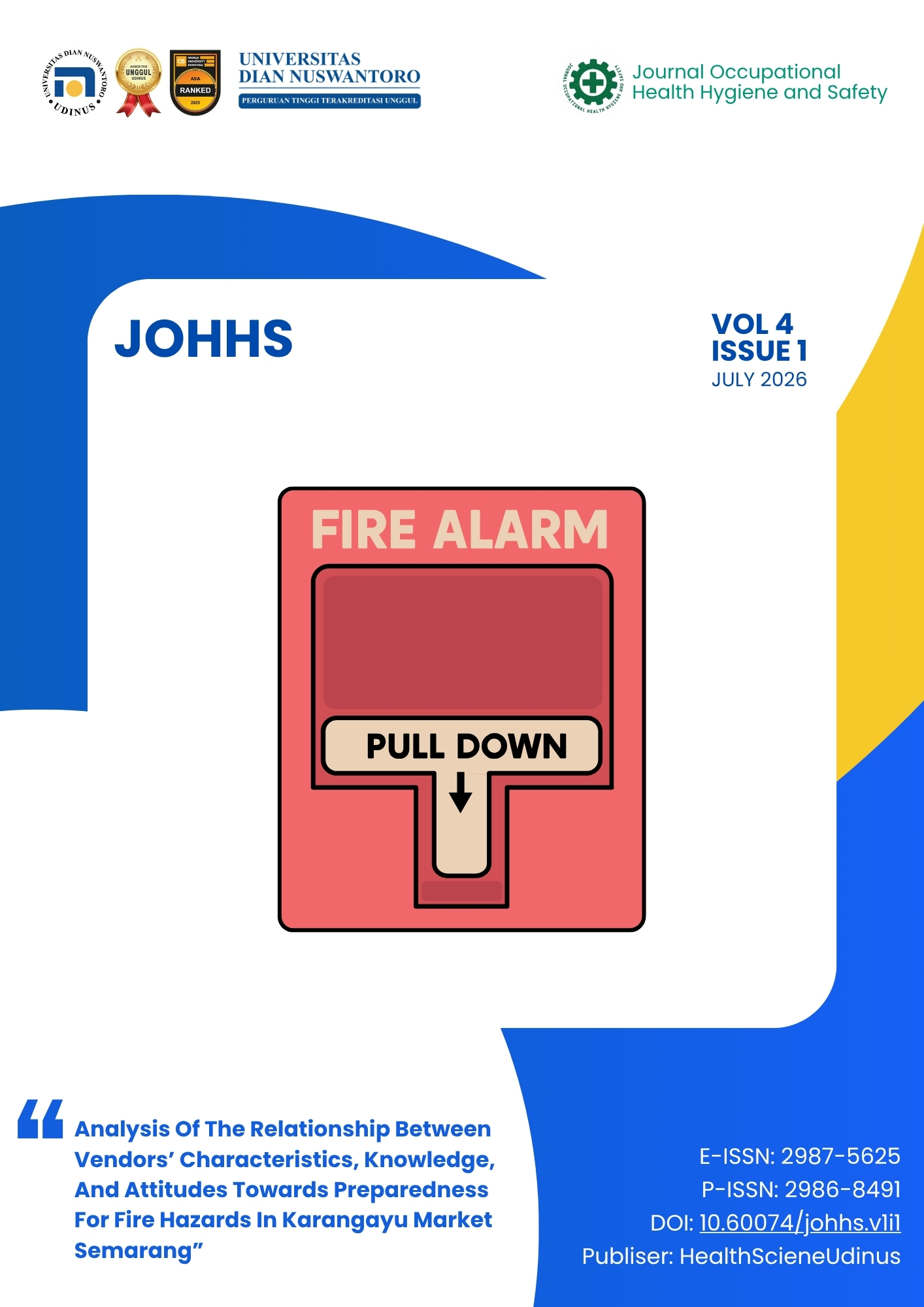
Analysis Of The Relationship Between Vendors’ Characteristics, Knowledge, And Attitudes Towards Preparedness For Fire Hazards In Karangayu Market Semarang
DOI:
https://doi.org/10.60074/johhs.v4i1.16208Keywords:
Preparedness, Market Traders, Potential FireAbstract
Markets as public facilities with high activity have potential fire hazard risks due to electrical installations, flammable materials, and building and visitor density. This study aims to analyze the relationship between characteristics, knowledge, and attitudes with the preparedness of traditional market traders to potential fire hazard risks. This study was conducted from October 2025 to February 2026 using an observational analytical design with a cross-sectional approach on 95 Karangayu market traders determined by the Slovin formula and accidental sampling techniques. Data were collected using questionnaires and observations, then analyzed univariately and bivariately using Spearman's Rank and Eta Association. The results show that respondents were predominantly female (72.6%), with an average age of 45 years and 15 years of trading experience. Statistical results showed a relationship between length of service (p=0.042), knowledge (p=0.001), and attitude (p=0.001) with preparedness, while gender (p=0.961), age (p=0.405), education level (p=0.847), and fire experience (p=0.591) were not related. In conclusion, vendor preparedness is influenced by length of service, knowledge, and attitude. It is recommended that market managers improve fire protection facilities and vendors increase their awareness of potential fire risks.References
Central Statistics Agency. People's Market Directory 2024. ll. Nuvritasari E, Suska W, editors. Semarang: Central Statistics Agency/BPS-Statistics Indonesia; 2024. 1228 p.
Al Fiqri A, Hutari F. Facts about market fires during 2021. [cited 2025 Sep 28]. p. 1.
Aristyavani I. Risk Communication and the Importance of Market Fire Insurance. Tugu Insur. 2022; (May).
Niam Jamil A. Ngawen Blora Market Burns Down, Regency Government: Losses Estimated at IDR 30.6 Billion. 01-10-2024. 2024 [cited 2024 Aug 25]. p. 1.
Murti AS. Taman Puring Market Fire, Losses Estimated at IDR 30 Billion. July 29, 2025. [cited 2025 Aug 25]. p. 1.
Fahmi R, Santi TD, Arlianti N, Wardiati, Septiani R. Factors Related to Employee Knowledge of Fire Disaster Preparedness at PT Trans Dana Profitri. Indones J Econ Manag Technol. 2025;9(3):757–68.
Setianingsih S, Setianingrum GS, Darwati LE, Anggraeni R. Knowledge and Attitudes of the Academic Community Regarding Campus Fire Disaster Risk. J Nurse Researcher Prof. 2023;5(3):905–14.
Kinanti MP, Porusia M. Factors Related to Fire Emergency Response Preparedness among Employees of the Tirta Jungporo Regional Drinking Water Company, Jepara Regency. Heal Inf J Researcher. 2023;15(2):1–10.
Riska N, Rachmah, Mahdarsari M, Jannah N, Yullyzar. Nurses' Preparedness for Facing Disasters in the Inpatient Ward of RSUDZA Banda Aceh. Nurses' Preparedness for Facing Disasters in the Ward of Dr. Zainoel Abidin Regional General Hospital. J Healthc Technol Med. 2025;11(1):197–203.
Junus D, Agata G. The Relationship Between Nurses' Knowledge, Attitudes, and Experiences and Disaster Preparedness at Faisal Islamic Hospital, Makassar. J Indonesian Health Researcher. 2022;5(1):32–9.
Rahmayanti YN, Wulandari D, Novitayanti E, Papahan Indah G. The Effect of Disaster Education on Disaster Preparedness. J Nursing and Midwifery Science.2024;15(2):267–71.
Dahlia, Harokan Ali, Gustina E. Analysis of Factors Related to Fire Preparedness in Regional General Hospitals.Cendekia Med J Stikes Al-Ma`arif Baturaja.2023;8(2):308–16.
Natasha Amanda, Wiwik Eko Pertiwi HK. Factors Related to Fire Emergency Response Preparedness in Hospitals. J JOUBAHS. 2025;05(2):227–34.
Anis AY, Lestantyo D, Ekawati. Predisposing, Enabling, and Reinforcing Factors Related to Mental Hospital Nurses' Preparedness in Facing Fire Hazards. J Kesehat Masy. 2020;8(6):804–11.
A.W INA. Evaluation of Fire Hazard Management. J Public Health Quality. 2020;3(2):619–25.
Akter S. Analyzing Disaster Preparedness at the Personal and Community Level: Senior Citizens in Bangladesh. J Earth and Environmental Sciences, Dhaka University.2025;14(2):1-15
N. M, CK. AC. Demographic Factors Influencing Fire Safety Behavior in High-Rise Residential Buildings: A Survey-Based Behavioral Analysis from Bengaluru, India. J ETASR. 2026;16(2):336–34.
Kinasih LV, Syuhada AD, Ahmad N, Dewita T. Factors Associated with Fire Emergency Preparedness. J Heal Res Sci. 2025;5(02):407–15.
Jamal, Fauzi A, Jading RN, Parisma WI, Permata HR. The Relationship Between Length of Service, Worker Knowledge, and Availability of Facilities and Fire Emergency Preparedness in Shop 1 of PT. X, Batam City. J Liga Ilmu Serantau [Internet]. 2025;2(1):53–61.
Sahrani, Russeng SS, Muis M, Naiem F, Thamrin Y, Wahiduddin. Employee and management preparedness in facing fire disasters at public gas stations in Pinrang District. Rev Gest Soc and Ambient. 2024;18(3):1–17.
Omarbek A, Iyama K, Otaguro T, Tajima G, Yamashita K, Tasaki O. Willingness to engage in nuclear or radiological emergency response among medical personnel at four university hospitals in Kyushu, Japan. J Radiat Res. 2026;67(2):182–90.
Wulandari DE, Amaliah RU, Sundaru A. The Relationship between Worker Competence and Fire Emergency Response Preparedness at PT.X Warehouse, Batam City, 2023. J Kesehat Ibnu Sina. 2024;5(1):32–41.
Anwar DF, Sudiono, Santoso SB. Level of Knowledge and Attitude of Families Towards House Fire Prevention Efforts in Tanjungrasa Village, Patokbeusi District, Subang Regency in 2022. Horoscope Med J Heal Sci. 2022;01(01):31–7.
Amalia DN, Lesmana H, Alfianur, Hidaya N, Nugraha MA, Kartanti NI. Community Knowledge and Attitudes in Preparedness for Coastal Fires: A Correlation Study. J Health. 2025;18(2):143–52.
Downloads
Published
Issue
Section
License
Copyright (c) 2026 Julia Novitasari, MG Catur Yuantari

This work is licensed under a Creative Commons Attribution-NonCommercial-ShareAlike 4.0 International License.
The authors retain the copyright of this work and grant Journal of Occupational Health, Hygiene and Safety (JOHHS) the right of first publication. The work is simultaneously licensed under a Creative Commons Attribution-NonCommercial-ShareAlike 4.0 International License (CC BY-NC-SA 4.0), which permits use, distribution, and reproduction in any medium for non-commercial purposes, provided the original author(s) and the initial publication in this journal are properly credited, and any derivative works are distributed under the same license.
The authors are permitted to copy and redistribute the published version of the work, including posting it to an institutional repository or including it in a book, with acknowledgment of its initial publication in Journal of Occupational Health, Hygiene and Safety (JOHHS).