MODEL ANALYTICAL HIERARCHY PROCESS UNTUK SISTEM PENDUKUNG KEPUTUSAN PENILAIAN KARYAWAN PADA INSTANSI KESATUAN BANGSA POLITIK DAN PELINDUNGAN MASYARAKAT PROPINSI JAWA TENGAH
DOI:
https://doi.org/10.33633/tc.v12i4.804Abstract
Pengelolaan data penilaian karyawan dalam pelaksanaanya memerlukan sistem yang mampu mengelola penilaian karyawan secara lebih tepat dan efektif. Penelitian ini membahas rancangan sistem pendukung keputusan reward and punishment di instansi Kesatuan Bangsa Politik dan Perlindungan Masyarakat Provinsi Jawa Tengah. Tujuan dari penelitian ini adalah membuat rancangan sistem pendukung keputusan penilaian karyawan pada Kesatuan Bangsa Politik dan Perlindungan Masyarakat Provinsi Jawa Tengah. Metode yang digunakan dalam pendukung keputusan adalah analytical hierarchy process, sedangkan desain system menggunakan System Development Life Cycle. Dengan sistem ini penentuan reward dan punishment dapat dilakukan dengan lebih efektif. Kata Kunci: Sistem Pendukung Keputusan, Reward and Punishment, Analytical Hierarchy Process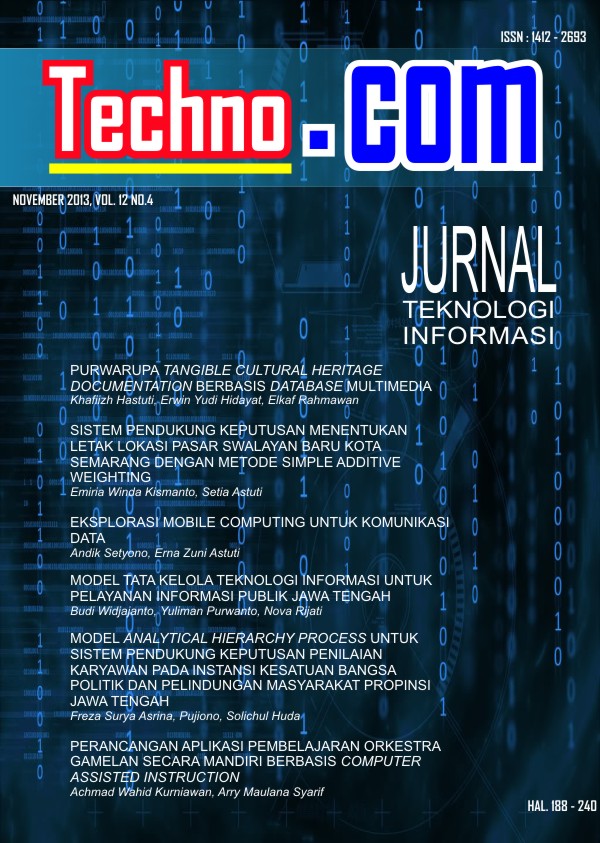
Downloads
Published
Issue
Section
License
Copyright (c) 2013 Freza Surya Asrina, Pujiono Pujiono, Solichul Huda

This work is licensed under a Creative Commons Attribution-NonCommercial 4.0 International License.
License Terms
All articles published in Techno.COM Journal are licensed under the Creative Commons Attribution-NonCommercial 4.0 International (CC BY-NC 4.0). This means:
1. Attribution
Readers and users are free to:
-
Share – Copy and redistribute the material in any medium or format.
-
Adapt – Remix, transform, and build upon the material.
As long as proper credit is given to the original work by citing the author(s) and the journal.
2. Non-Commercial Use
-
The material cannot be used for commercial purposes.
-
Commercial use includes selling the content, using it in commercial advertising, or integrating it into products/services for profit.
3. Rights of Authors
-
Authors retain copyright and grant Techno.COM Journal the right to publish the article.
-
Authors can distribute their work (e.g., in institutional repositories or personal websites) with proper acknowledgment of the journal.
4. No Additional Restrictions
-
The journal cannot apply legal terms or technological measures that restrict others from using the material in ways allowed by the license.
5. Disclaimer
-
The journal is not responsible for how the published content is used by third parties.
-
The opinions expressed in the articles are solely those of the authors.
For more details, visit the Creative Commons License Page:
? https://creativecommons.org/licenses/by-nc/4.0/