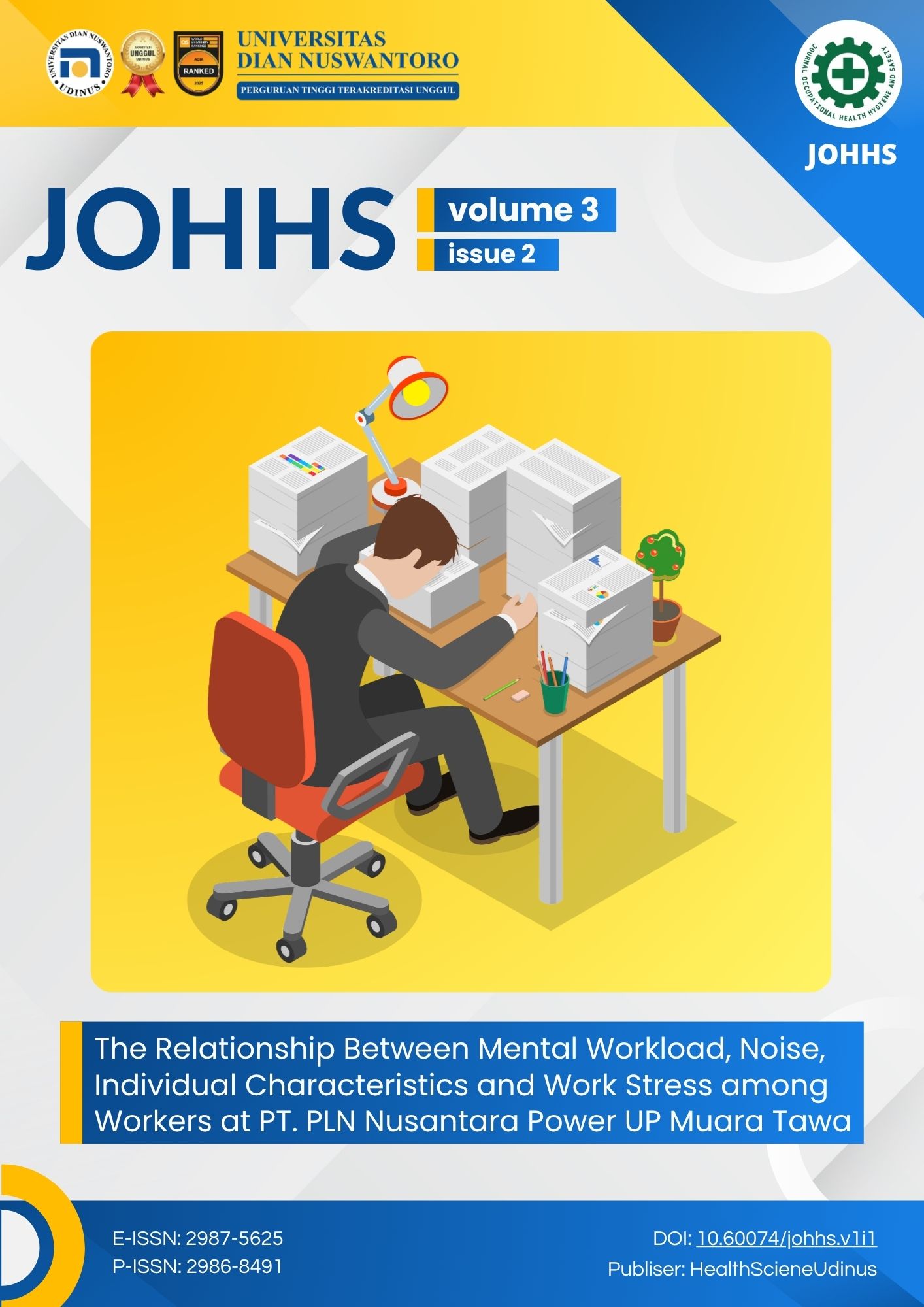
The Relationship Between Mental Workload, Noise, Individual Characteristics and Work Stress among Workers at PT. PLN Nusantara Power UP Muara Tawar
DOI:
https://doi.org/10.60074/johhs.v3i2.12866Keywords:
Work stress , Mental workload , Noise , Individual characteristicsAbstract
Work environments demanding high productivity often ignore workers' psychological aspects, triggering work stress. Job stress is an individual's response to work pressure exceeding their coping ability. A main cause is mental workload—an individual's perception of task weight to be completed within certain time and conditions. Additionally, workplace noise can worsen psychological conditions, especially if continuous. Individual characteristics such as age, length of service, and education level also determine a person's vulnerability to stress. These factors, if not properly managed, can negatively impact worker health, safety, and productivity. This study analyzed the relationship between mental workload, noise, individual characteristics, and work stress using quantitative methods with cross-sectional design. The population comprised 134 workers in noise areas divided into 4 fields: operators, machine maintenance, electrical maintenance, and control & instrument maintenance. Using proportionate stratified sampling and accidental sampling techniques, 60 samples were obtained. Results showed 76.7% of respondents experienced moderate work stress, with the most dominant cause being qualitative overload (33.3%). Chi-square test analysis revealed a relationship between mental workload and work stress (p-value = 0.003). However, noise (p-value = 0.422), age (p-value = 0.512), length of service (p-value = 0.259), and education level (p-value = 0.201) were not related to work stress. In conclusion, there is a significant relationship between mental workload and work stress among workers at PT. PLN Nusantara Power UP Muara Tawar. Therefore, it is important for companies to identify and manage stress-inducing factors to create a healthy and sustainable work environment.References
Amalia R, Herwanto D, Rana Zahra W. Analisis Potensi Bahaya Dan Risiko Kecelakaan Kerja Dengan Menggunakan Metode Hazard Identification Risk Assessment And Risk Control (HIRARC) Pada Pemotongan Kayu. Ind Inov J Tek Ind [Internet]. 2023;13(1):13–9. Available from: http://dx.doi.org/10.36040/industri.v13i1.4523
Mualim M, Adeko R. Faktor-Faktor Yang Berhubungan Dengan Stres Kerja Pada Pekerja Bagian Dryer PT. Bukit Angkasa Makmur (BAM) Di Kabupaten Bengkulu Tengah. J Nurs Public Heal [Internet]. 2020;8(1):79–86. Available from: http://dx.doi.org/10.37676/jnph.v8i1.1017
Ningrum FIK, Marsanti A, Wibowo PA. Hubungan Intensitas Kebisingan Dengan Stres Kerja Pada Pekerja Bagian Produksi. Media Bina Ilm. 2022;17(2):253–62.
Nafs T. Pengaruh Beban Kerja terhadap Stres Kerja pada Guru Tahfidz di Pesantren Terpadu Darul Qur’an Mulia. Acta Psychol [Internet]. 2020;2(2):199–208. Available from: http://dx.doi.org/10.21831/ap.v2i2.35106
Suryani AI, Muliawan P, Adiputra N. Hubungan beban kerja dengan stres kerja pada karyawan garmen di kota Denpasar. J Penelit dan Kaji Ilm Kesehat Politek Medica Farma Husada Mataram. 2020;6:143–8.
Mauliya D, Putra G. Evaluasi Tingkat Kebisingan Ruang Operator Di Unit Pelaksana Pembangkitan Nagan Raya (UPKNGR). SITEKIN J Sains, Teknol dan Ind. 2022;20(1):98–107.
Awalia MJ, Medyati NJ, Giay ZJ. Hubungan Umur Dan Jenis Kelamin Dengan Stress Kerja Pada Perawat Di Ruang Rawat Inap RSUD Kwaingga Kabupaten Keerom. JISIP (Jurnal Ilmu Sos dan Pendidikan) [Internet]. 2021;5(2). Available from: http://dx.doi.org/10.36312/jisip.v5i2.1824
’Aini ZK, Paskarini I. Hubungan Beban Kerja Fisik dan Shift Kerja dengan Kelelahan Kerja Subjektif Pekerja Shift (Studi Pada Pekerja Shift di Puskesmas Kepohbaru, Kab. Bojonegoro). Prev J Kesehat Masy [Internet]. 2022;13(4):596–610. Available from: http://dx.doi.org/10.22487/preventif.v13i4.330
Nugroho BYS, Putri VA, Rahmadani FV, Maharani LF, Wulandari EE, Pratama BA, et al. Age, Sleep, Fatigue, and Body Mass Index Patterns in Central Java Bus Drivers: Multi-Route Occupational Health Assessment. Indones J Occup Saf Heal. 2025;14(2):178–87.
Putra RVD, Zainuddin A, Yasnani Y. Faktor Yang Berhubungan Dengan Stres Kerja Pada Pekerja Bagian Smelting PT Antam Unit Bisnis Pertambangan Nikel Kolaka. J Kesehat Lingkung Univ Halu Oleo [Internet]. 2023;4(3). Available from: http://dx.doi.org/10.37887/jkl-uho.v4i3.46692
Putri DN, Lestari F. Analisis Penyebab Kecelakaan Kerja Pada Pekerja di Proyek Konstruksi : Literatur Review. J Kesehat Masy [Internet]. 2023 Jun 1 [cited 2023 Jul 12];7(1):444–60. Available from: http://journal.universitaspahlawan.ac.id/index.php/prepotif/article/view/13281
Yoni B, Nugroho S, Widianawati E, Wulan WR, Keselamatan P, Kerja K, et al. Gambaran Keluhan Otot Antara School From Home Dan Work From Home Dalam Pandemi Covid-19. VISIKES J Kesehat Masy [Internet]. 2020 Nov 3 [cited 2022 Feb 20];19(2). Available from: http://publikasi.dinus.ac.id/index.php/visikes/article/view/4030
Nurdin DM, Suroto S, Lestantyo D. Hubungan Antara Bagian Operasi Dan Pemeliharaan Terhadap Stres Kerja Pada Pekerja Di Pembangkit Listrik PT X. Jambura J Heal Sci Res [Internet]. 2024;6(4):374–85. Available from: http://dx.doi.org/10.35971/jjhsr.v6i4.27091
Justin YK. Hubungan Kebisingan Dan Tekanan Panas Dengan Stres Kerja Pada Pekerja Mebel Bagian Milling di PT Alis Jaya Ciptatama Klaten. J Kesehat Masy [Internet]. 2022;10(2):148–55. Available from: http://dx.doi.org/10.14710/jkm.v10i2.32265
Mirani N, Sumardi. Hubungan Beban Kerja dan Stres Kerja dengan Kelelahan Kerja pada Perawat di Instalasi Bedah Sentral Rumah Sakit Umum Daerah Kota Langsa Tahun 2019. J EDUKES (Jurnal Penelit Edukasi Kesehatan) [Internet]. 2020;30–9. Available from: http://dx.doi.org/10.52136/edukes.v3i1.24
Downloads
Published
Issue
Section
License
Copyright (c) 2026 Kania Fitrianti Zahrah, Ida Wahyuni, Ekawati Ekawati

This work is licensed under a Creative Commons Attribution-NonCommercial-ShareAlike 4.0 International License.
The authors retain the copyright of this work and grant Journal of Occupational Health, Hygiene and Safety (JOHHS) the right of first publication. The work is simultaneously licensed under a Creative Commons Attribution-NonCommercial-ShareAlike 4.0 International License (CC BY-NC-SA 4.0), which permits use, distribution, and reproduction in any medium for non-commercial purposes, provided the original author(s) and the initial publication in this journal are properly credited, and any derivative works are distributed under the same license.
The authors are permitted to copy and redistribute the published version of the work, including posting it to an institutional repository or including it in a book, with acknowledgment of its initial publication in Journal of Occupational Health, Hygiene and Safety (JOHHS).