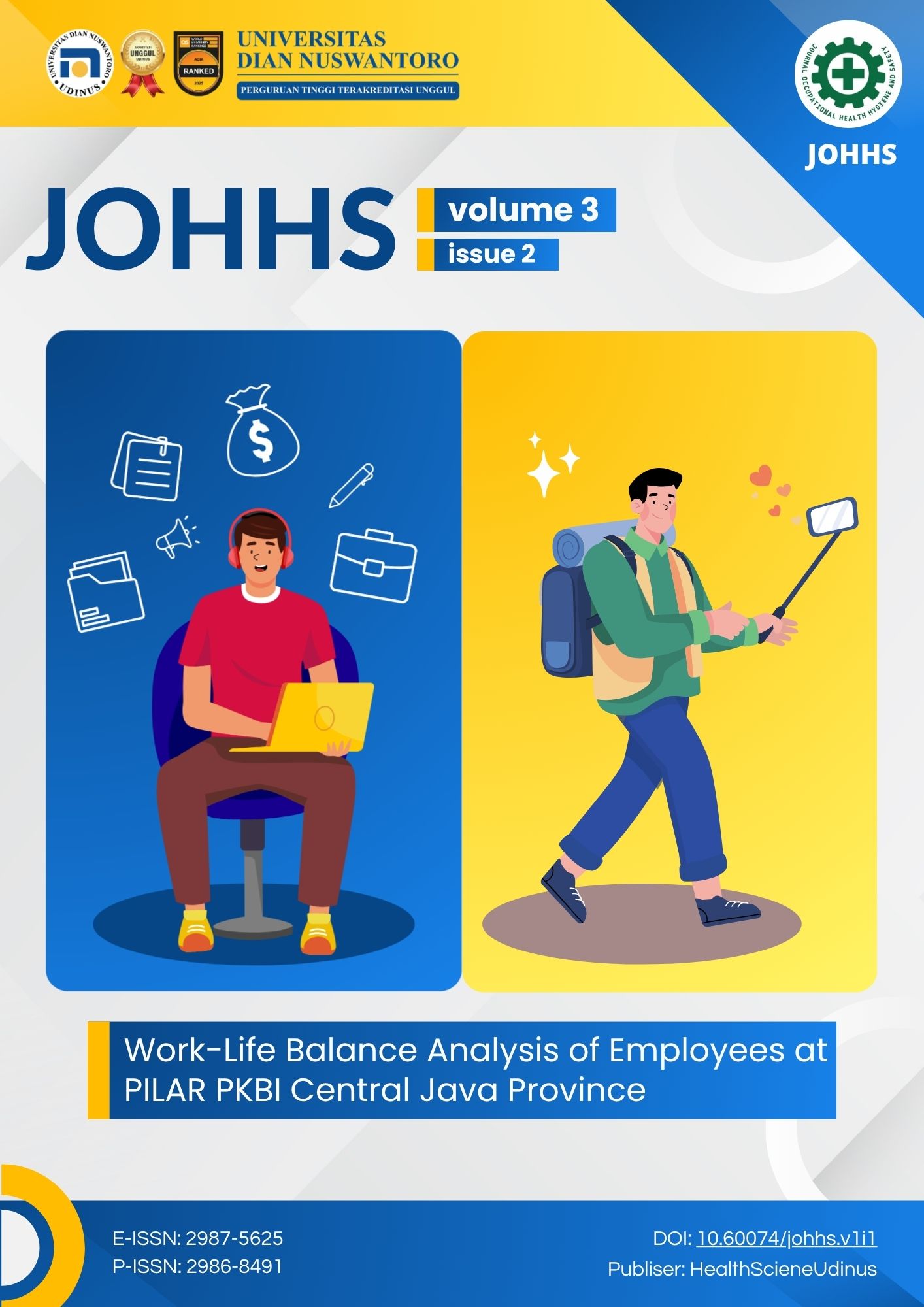
Work-Life Balance Analysis of Employees at PILAR PKBI Central Java Province
DOI:
https://doi.org/10.60074/johhs.v3i2.12660Keywords:
Work-Life Balance, Personal Life, Work Flexibility, Social Support, EmployeesAbstract
Work-life balance (WLB) has become one of the key issues in today’s working environment, including among employees of non-profit organizations such as the Indonesian Family Planning Association (PKBI) of Central Java Province. WLB refers to a condition in which individuals can allocate their time and energy evenly between work and personal life, which in turn can improve quality of life, mental well-being, and productivity. However, achieving WLB is not easy and is influenced by various factors. This study uses a descriptive qualitative approach. Data were collected through in-depth interviews using open-ended questions to explore the informants’ views and experiences regarding work-life balance. Based on interviews with employees at PKBI, it can be concluded that maintaining a balance between work and personal life is a top priority for them. However, efforts to achieve this balance are affected by the unpredictable nature of their work, which often requires a high degree of flexibility in managing time and tasks.References
Nugroho BYS, Putri VA, Rahmadani FV, Maharani LF, Wulandari EE, Pratama BA, et al. Age, Sleep, Fatigue, and Body Mass Index Patterns in Central Java Bus Drivers: Multi-Route Occupational Health Assessment. Indones J Occup Saf Heal. 2025;14(2):178–87.
Nur Intan Maslichah Kadarisman Hidayat. KEPUASAN KERJA KARYAWAN ( Studi pada Perawat RS Lavalette Malang Tahun 2016 ). J Adm Bisnis. 2017;49(1):60–8.
Indra FJ, Rialmi Z. Pengaruh Work-Life Balance, Burnout, dan Lingkungan Kerja Terhadap Kepuasan Kerja Karyawan (Studi Kasus Pada Karyawan PT Meka Eduversity Komunikasi). J Madani Ilmu Pengetahuan, Teknol dan Hum. 2022;5(2):90–9.
Malik M, Shamshir M, Khan K. Association of work-life balance and job satisfaction in commercial pilots: a case study of Pakistan. Indep J Manag Prod. 2020;11(3):998–1017.
Dua MHC, Hyronimus. Pengaruh Work From Home Terhadap Work-Life Balance Pekerja Perempuan Di Kota Ende. J Ilm Manaj Bisnis Dan Inov Univ Sam Ratulangi. 2020;7(2):2047–258.
Hendra D, Artha B. Work-Life Balance: Suatu Studi Literatur. Innov J Soc Sci Res. 2023;3(3):11320–30.
Program DN, Bisnis M, Manajemen S, Bisnis F, Ekonomi D. Pt Mustika Dharmajaya. 2019;7(2).
Pratiwi MA, Haryani DS, Putri AS. Work-Life Balance Dan Kepuasan Ke Rja Pada Pekerja Di Non-Profit Organization Kota Tanjungpinang. J Inov Penelit. 2021;2(2):397–408.
Aryateja KB, Susita D, Dianta K, Sebayang A. The Influence of Work-Life Balance and Work Environment on Employee Commitment. Int J Soc Sci World. 2021;2(2):97–109.
Wang Y. Work-Family Conflict and Balance Strategies—An Analysis Based on the Work-Family Resources Model. Open J Bus Manag. 2024;12(02):1228–39.
Sugiyono. Metode Penelitian Kuantitatif, Kualitatif dan R&D. Alfabeta. Bandung; 2009.
Berger DL. Does work-life boundary management improve work-life balance for remote workers: A critically appraised topic. Engag Manag Rev. 2023;7(1).
Mirbabaie M, Marx J. Micro-level dynamics in digital transformation: Understanding work-life role transitions. Inf Syst J. 2024;34(5):1810–32.
Yadav P. Flexible work culture : prospects and trends through a bibliometric. 2024;
Chen IS. Extending the job demands–resources model to understand the effect of the interactions between home and work domains on work engagement. Stress Heal. 2024;40(4).
Ranti Nurbayanti, Dwarawati D. Pengaruh Work Engagement terhadap Work-Family Enrichment pada Perawat Gigi. Bandung Conf Ser Psychol Sci. 2023;3(1):373–80.
Kossek EE, Porter CM, Rosokha LM, Wilson KS, Rupp DE, Law-Penrose J. Advancing work–life supportive contexts for the “haves” and “have nots”: Integrating supervisor training with work–life flexibility to impact exhaustion or engagement. Hum Resour Manage. 2024;63(3):397–411.
Downloads
Published
Issue
Section
License
Copyright (c) 2026 Putri Ayu Anita, Khairani Zikrinawati, Lucky A de Sessiani

This work is licensed under a Creative Commons Attribution-NonCommercial-ShareAlike 4.0 International License.
The authors retain the copyright of this work and grant Journal of Occupational Health, Hygiene and Safety (JOHHS) the right of first publication. The work is simultaneously licensed under a Creative Commons Attribution-NonCommercial-ShareAlike 4.0 International License (CC BY-NC-SA 4.0), which permits use, distribution, and reproduction in any medium for non-commercial purposes, provided the original author(s) and the initial publication in this journal are properly credited, and any derivative works are distributed under the same license.
The authors are permitted to copy and redistribute the published version of the work, including posting it to an institutional repository or including it in a book, with acknowledgment of its initial publication in Journal of Occupational Health, Hygiene and Safety (JOHHS).