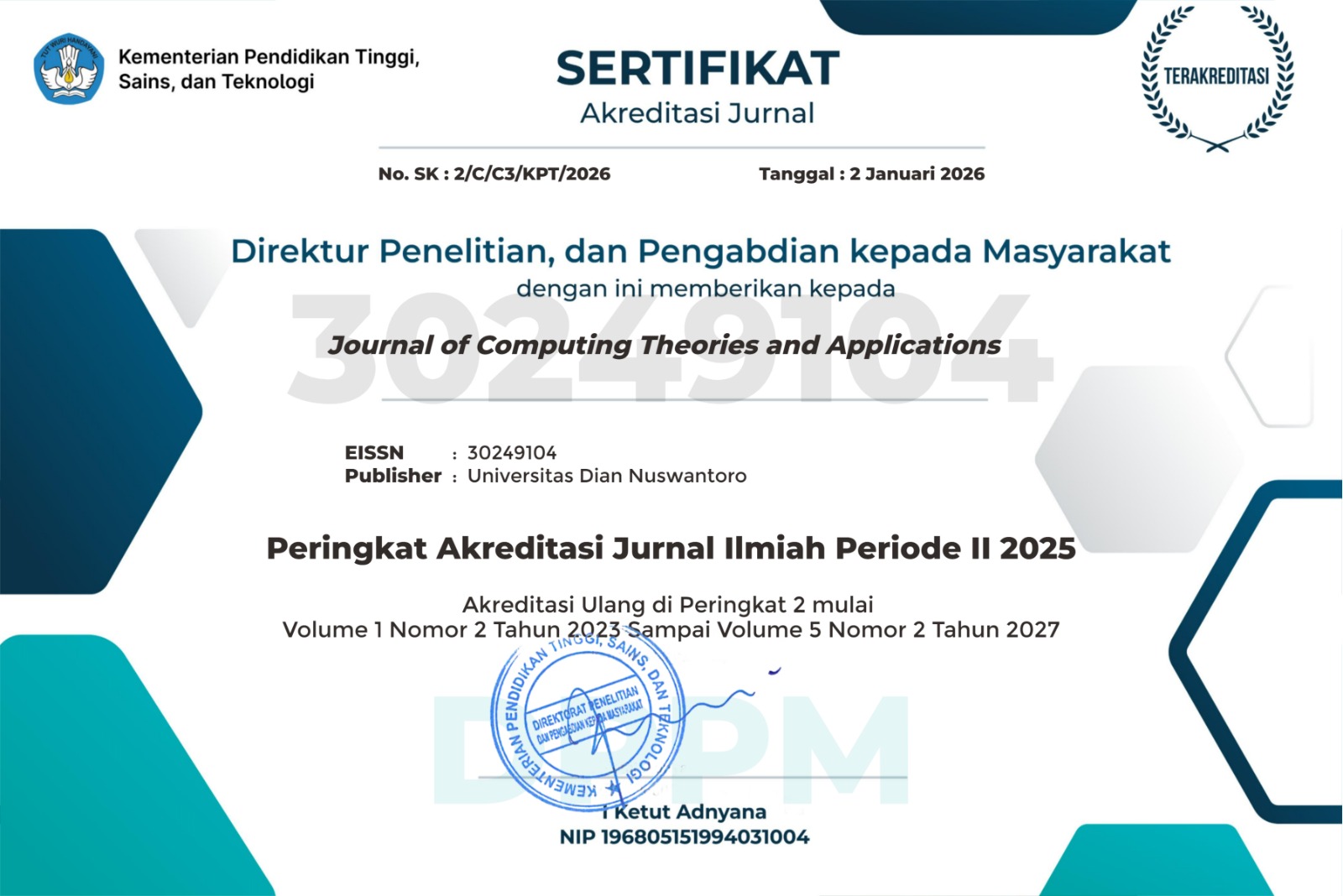
JCTA is now indexed in Scopus (Q3) and accredited as SINTA 2
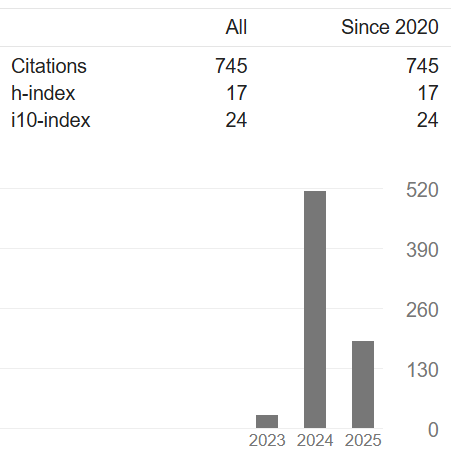
Journal of Computing Theories and Applications (JCTA) is a peer-reviewed international journal that covers all aspects of foundations, theories, and applications in computer science. All accepted articles are published online, assigned a DOI via Crossref, and made freely accessible (Open Access). The journal follows a rapid editorial and peer-review process. Authors typically receive the first decision within one week, while the overall first-round peer-review process is generally completed within four weeks.
Artificial Intelligence
Big Data
Bioinformatics
Biometrics
Cloud Computing
Computer Graphics
Computer Vision
Cryptography
Data Mining
Fuzzy Systems
Game Technology
Image Processing
Information Security
Internet of Things
Intelligent Systems
Machine Learning
Mobile Computing
Multimedia Technology
Natural Language Processing
Network Security
Pattern Recognition
Quantum Informatics
Signal Processing
Soft Computing
Speech Processing
Special emphasis is given to recent trends related to cutting-edge research within the domain.
All manuscripts undergo a pre-review by the handling editor before being reviewed anonymously by appointed reviewers in a single-blind process, according to their field of expertise. The decision to accept, revise, or decline a manuscript will be communicated in writing via email. Authors are given one month to make revisions based on feedback from reviewers and editors. If additional time is needed or if there are issues with submitting revisions, please get in touch with editorial.jcta@gmail.com.
The Journal of Computing Theories and Applications (JCTA) is an open-access journal, which means that all content is freely available without charge to the user or institution.
All articles published in JCTA are licensed under the Creative Commons Attribution 4.0 International License (CC BY 4.0).
Authors retain the copyright of their articles and grant the journal a non-exclusive license to publish. Users are allowed to read, download, copy, distribute, print, search, or link to the full texts of the articles or use them for any other lawful purpose without asking prior permission from the publisher or the author, as long as proper citation is given.
The JCTA is committed to upholding the highest standards of publication ethics in accordance with the COPE Core Practices. The journal ensures that all parties involved in the publication process — authors, editors, reviewers, and the publisher — adhere to ethical principles to maintain the integrity of scholarly communication.
Integrity – Upholding accuracy, transparency, and honesty in research and its presentation.
Originality – All submissions must be original works, free from fabrication, falsification, plagiarism, or inappropriate self-plagiarism.
Accountability – All parties take responsibility for their contributions and decisions in the publication process.
Transparency – Clear disclosure of funding sources, conflicts of interest, and use of third-party tools.
Fairness – Editorial decisions are based solely on academic merit and relevance to the journal’s scope.
Editors are responsible for:
Making fair, unbiased decisions regardless of race, gender, sexual orientation, religious belief, ethnic origin, citizenship, or political philosophy of the authors.
Ensuring all manuscripts undergo an objective and timely peer-review process.
Maintaining confidentiality of submitted manuscripts and not using unpublished information for personal advantage.
Taking appropriate action when ethical concerns are raised, including issuing corrections, retractions, or expressions of concern in line with COPE guidelines.
Preventing any conflicts of interest from influencing editorial decisions.
Reviewers are expected to:
Provide constructive, objective, and timely feedback to improve the quality of the manuscript.
Maintain the confidentiality of all materials received for review.
Decline reviews if there is a conflict of interest or insufficient expertise.
Report suspected ethical breaches to the editor, such as plagiarism, data fabrication, or duplicate publication.
Authors must:
Submit original work that has not been published elsewhere and is not under consideration by another journal.
Properly acknowledge all sources and obtain permissions for copyrighted material.
Disclose all funding sources and any potential conflicts of interest.
Ensure that all listed authors have made a significant contribution to the work, approved the final version, and agreed to its submission.
Cooperate fully during the peer-review and revision process.
Promptly notify the editor if significant errors are discovered after publication, and work with the editor to correct or retract the paper when necessary.
AUTHORSHIP:
Authorship and co-authorship should be based on a substantial intellectual contribution. It is assumed that all authors have had a significant role in the creation of an article that bears their names. Therefore, the list of authors in an article serves multiple purposes; it indicates who is responsible for the work and to whom questions regarding the work should be addressed. Moreover, the credit implied by authorship is often used as a measure of the contributors’ productivity when they are evaluated for employment, promotions, grants, and prizes.
If the article has been accepted, the author must fill out an Author Statement regarding the Code of Ethics for Scientific Publications, which the corresponding author signs.
Journal Partner
JCTA is now indexed in Scopus (Q3) and accredited as SINTA 2
.:JOURNAL MENU:.
Open Access Policy and Journal License
Similarity and AI Tools Policy
.:AUTHORS' DIVERSITY:.
Total: 28 countries from 4 continents
Africa (10 countries): Algeria; Burkina Faso; Burundi; Democratic Republic of the Congo; Egypt, Kenya; Morocco; Nigeria; Senegal; Tunisia
Asia (14 countries): Bahrain; Bangladesh; China; India; Indonesia; Iraq; Malaysia; Myanmar; Nepal; Pakistan; South Korea; Sri Lanka; Turkey; Viet Nam
Americas (2 countries): Peru; United States
Europe (2 countries): Russian Federation; United Kingdom
.:VISITORS:.
.:JOURNAL STATICTICS:.
| Year | Acceptance Rate | Days to First Decision |
|---|---|---|
| 2025 | 35% | 2 days |
| 2024 | 45% | 3 days |
Journal of Computing Theories and Applications (JCTA) is an international peer-reviewed journal published by Universitas Dian Nuswantoro, Semarang, Indonesia, in collaboration with the Intelligent System (IntSys) Research Lab.
The journal is managed by Future Techno Science.
 |
 |
 |
 |
Indexed by:
 |
 |
 |
 |
 |
 |
 |
 |
 |
| This journal is licensed under a Creative Commons Attribution 4.0 International License. | ||||||||
 |
||||||||
ISSN: 3024-9104
