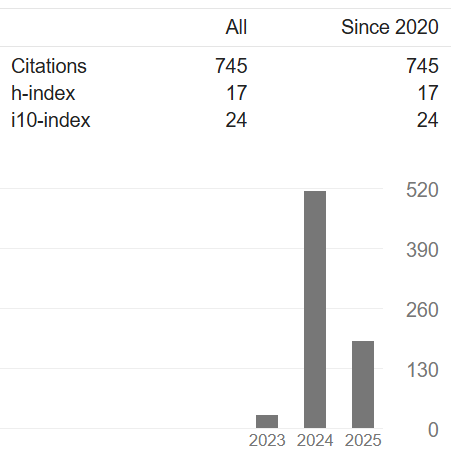
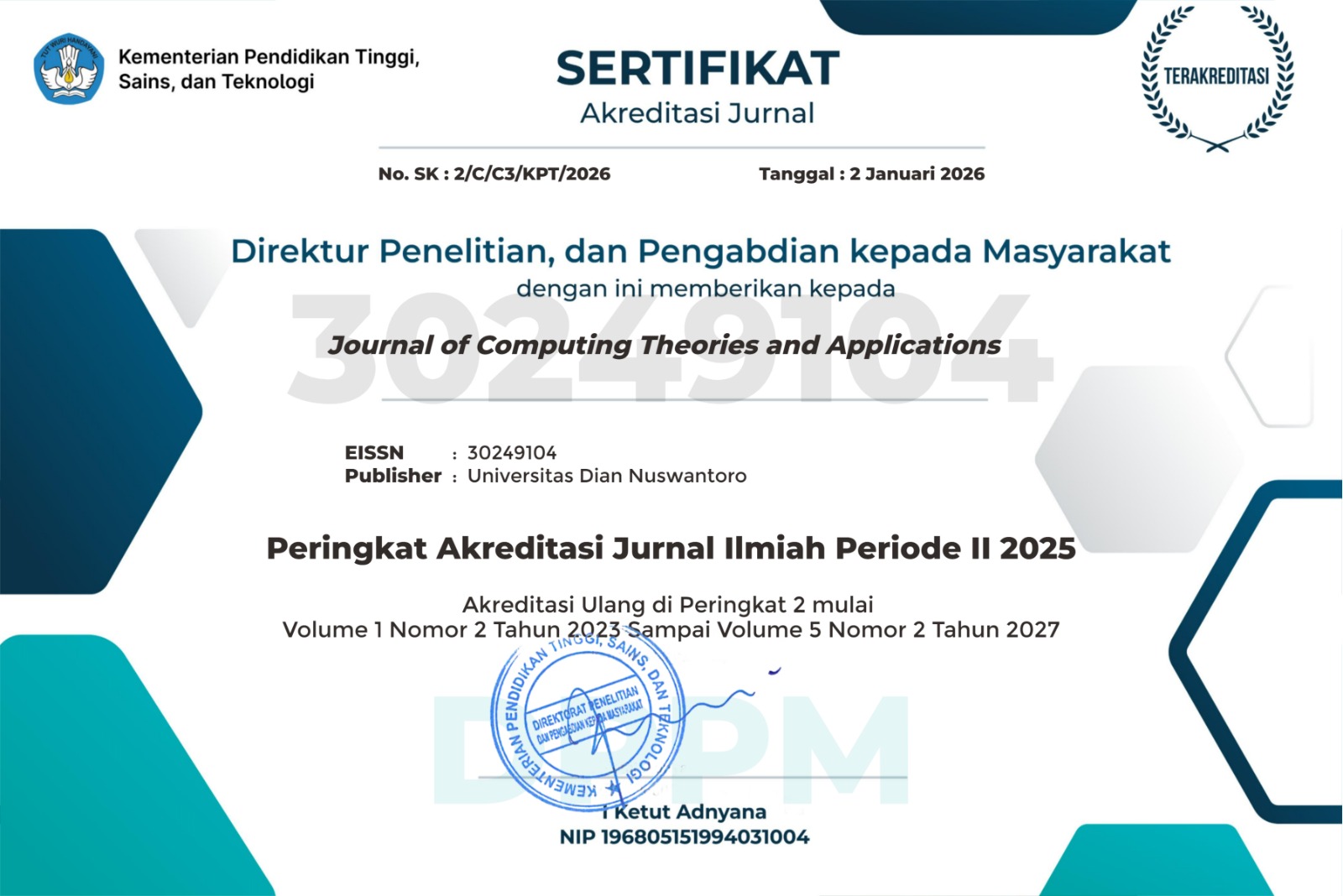
JCTA is now indexed in Scopus (Q3) and accredited as SINTA 2

All submissions to the Journal must be written in English and submitted through the JCTA OJS. Authors are required to register with the OJS before submitting a manuscript.
Manuscripts must be submitted as a single Word file containing the complete title, author names, affiliations, addresses, main text, figures, tables, references, and other relevant materials. Authors are encouraged to follow the margins, fonts, captions, and general formatting specified in the MS Word A4 template. Use of the journal template is recommended but not mandatory. Authors who experience difficulties using the template may submit the manuscript in a free-format layout, provided that it is prepared in a single-column format.
JCTA accepts both research and review articles and does not impose a strict minimum or maximum page limit. However, the recommended length is 12–20 pages for research articles and 20–30 pages for review articles. Authors should ensure that the manuscript provides sufficient detail and supporting evidence appropriate to the type and scope of the article.
JCTA also accepts manuscripts that have previously been posted as preprints. Authors must disclose any relevant preprint and include its URL, DOI, or other persistent identifier in the Acknowledgement section.
For information regarding publication fees and applicable page charges, authors are advised to refer to the Author Fees page and the journal template.
The author must be identified. He must also provide his email, geographic postal code, city, and country. Since Volume 3 Issue 3 (2026), at least the corresponding author must have an ORCID.
References must follow the IEEE style. We highly recommend preparing references with a bibliography software package like Mendeley, EndNote, or Zotero to avoid typos and duplicate entries. All references must include a DOI or other persistent identifier whenever available. If a reference does not have a DOI or identifier, authors are required to provide a valid URL to ensure that the cited work is accessible and verifiable online. Below is an example of a bibliography:
[1] D. R. I. M. Setiadi, S. Rustad, P. N. Andono, and G. F. Shidik, “Digital image steganography survey and investigation (goal, assessment, method, development, and dataset),” Signal Processing, vol. 206, p. 108908, May 2023, doi: 10.1016/j.sigpro.2022.108908.
[2] D. R. I. M. Setiadi, T. Sutojo, E. H. Rachmawanto, and C. A. Sari, “Fast and efficient image watermarking algorithm using discrete tchebichef transform,” in 2017 5th International Conference on Cyber and IT Service Management (CITSM), Aug. 2017, pp. 1–5. doi: 10.1109/CITSM.2017.8089229.
[3] A. Vyas, S. Yu, and J. Paik, “Fundamentals of Digital Image Processing,” in A John Wiley & Sons, 2018, pp. 3–11. doi: 10.1007/978-981-10-7272-7_1.
[4] ICCC FBI, “Internet Crime Report 2021,” 2022. [Online]. Available: https://www.ic3.gov/Media/PDF/AnnualReport/2021_IC3Report.pdf
[5] USC Viterbi School of Engineering, “SIPI Image Database.” http://sipi.usc.edu/database/ (accessed Mar. 27, 2019).
Authorship and co-authorship must be based on substantial intellectual contribution. All individuals listed as authors are expected to have played a meaningful role in the conception, execution, or interpretation of the work and to take public responsibility for its content. Authorship confers both academic credit and ethical accountability, and it is widely used as an indicator of scholarly contribution in professional evaluations, including employment, promotion, and research funding.
JCTA affirms that authorship credit should be granted only to individuals who meet all of the following criteria:
Have made a significant intellectual contribution to the theoretical framework, system or method design, experimental design, implementation or prototype development, and/or the analysis and interpretation of data.
Have participated in drafting the manuscript or critically revising it for important intellectual content.
Have approved the final version of the manuscript to be published and agree to be accountable for all aspects of the work.
The inclusion of deceased persons as authors is permitted, provided that a clear footnote indicates their passing. In multi-author manuscripts, the order of authorship is determined by mutual agreement among the authors. Once submitted, changes to the authorship list or order are considered exceptional and require the written consent of all living authors as well as editorial approval.
At least one author must take responsibility for each essential component of the work. For multi-author submissions, a corresponding author must be designated. The corresponding author is responsible for coordinating the submission and publication process, ensuring the integrity of the manuscript, obtaining consent from all co-authors, and keeping them informed throughout peer review and revision. All co-authors share collective responsibility for the work submitted under their names and are expected to remain familiar with its content and revision history.
Since Volume 3, Issue 4 (2026), JCTA has strengthened its authorship screening during the initial editorial assessment to promote transparency and responsible authorship practices.
Manuscripts listing more than 10 authors may be subject to additional editorial assessment. In such cases, authors may be requested to provide a brief justification explaining how the scope, methodology, or collaborative nature of the study reasonably warrants the number of authors listed.
If, after editorial assessment, the authorship composition is deemed insufficiently justified in relation to the study scope, the manuscript may be returned to the authors prior to peer review for clarification or revision.
Unclear or insufficiently justified authorship arrangements may raise concerns regarding authorship inflation or gift authorship and may influence editorial handling, in accordance with the journal’s publication ethics and COPE guidance.
JCTA recognizes that author self-citation can be a legitimate and necessary aspect of scholarly communication when prior work directly informs the submitted manuscript. Self-citations are therefore permitted, provided that they are used responsibly, transparently, and with clear scholarly justification.
Author self-citations are acceptable only when they are directly relevant to the methodology, data, algorithms, theoretical framework, or core technical contributions of the submitted work. They should not be used solely to support general background statements, artificially inflate citation counts, or compensate for insufficient engagement with the broader literature.
Since Volume 3, Issue 4 (2026), JCTA has strengthened its editorial assessment of author self-citation during the initial screening stage.
As a general quantitative guideline, author self-citations should not exceed 20% of the total reference list. Manuscripts exceeding this threshold may be subject to additional editorial scrutiny and may be returned to the authors for revision prior to peer review.
The editorial team may request authors to reduce, replace, or justify excessive self-citations, particularly when such citations originate from unrelated research domains or lack clear methodological relevance to the submitted work.
Before sending to review
Before a manuscript is sent for peer review, the editorial team will verify that it complies with the journal’s Similarity Policy and topic suitability.
Authors must ensure their manuscripts meet the similarity and originality requirements outlined on the Similarity Policy page, including limits on similarity index, self-citation rate, AI acknowledgement, and proper handling of figures and copyrighted materials.
Please review the full guidelines here: Similarity Policy & AI Tools Acknowledgement.
Revision Stage
The author must respond to the reviewer for revisions and/or rebuttal at the revision stage.
In addition, improvements must be marked with highlights, and the highlighted document files must be uploaded with the revised manuscript in the supplementary material for review.
The response template can be downloaded here.
An Article Processing Charge (APC) applies to accepted manuscripts and must be paid before the article proceeds to the production and publication process. The applicable APC is determined according to the journal’s current Author Fees policy. Any applicable discounts are subject to the journal’s current policy and editorial approval. Detailed information regarding applicable APCs, page charges, and available discounts is provided on the Author Fees page and in the journal template.
Once a manuscript is accepted, the corresponding author must upload the reference list in .bib or .ris format through the OJS system or send it directly to editorial.jcta@gmail.com. The reference list should be exported from a reference management tool such as Mendeley, Zotero, or EndNote. Authors are responsible for ensuring that all references are accurate and complete. All references should include a DOI or other persistent identifier whenever available. Authors may use the Crossref Simple Text Query to search for and verify DOI information. If a reference does not have a DOI or other persistent identifier, authors should provide a valid URL to ensure that the cited source is accessible and verifiable online.
After the reference file is received, the manuscript will proceed to the layout and production editing stage, managed by the journal’s production team. A proof version will then be provided to the corresponding author for final verification.
Authors are expected to carefully review the proof for formatting, typographical, and content-related issues and confirm their approval for publication. Minor corrections may be requested at this stage.
Once the proof has been approved, a DOI will be assigned, and the article will be published online, either in the Early Access section or as part of a specific issue.
Withdrawal Policy
A LOCKSS license will appear in About the Journal under Archiving: LOCKSS License. This enables LOCKSS to store and distribute journal content at participating libraries via a LOCKSS Publisher Manifest page.
The JCTA is committed to maintaining the integrity of the scholarly record and ensuring the reliability of published research. Retractions are issued when published findings are determined to be unreliable due to misconduct or significant error.
An article may be retracted for reasons including, but not limited to:
Plagiarism or Redundant Publication
Substantial overlap with previously published work without proper attribution, or duplicate publication without disclosure.
Data Fabrication or Falsification
Manipulated, fabricated, or unreliable data that compromise the validity of the findings.
Serious Ethical Violations
Breaches of research or publication ethics, including unauthorized use of copyrighted materials, undisclosed conflicts of interest, or unethical research practices.
Major Errors
Significant methodological, analytical, or interpretative errors that invalidate the conclusions of the study.
All retraction cases are handled in accordance with the Committee on Publication Ethics (COPE) Retraction Guidelines and the journal’s Publication Ethics policy.
Preliminary Assessment and Investigation
The editorial team evaluates the reported concerns. Authors are notified and given a fair opportunity to respond and provide clarification or supporting evidence.
Editorial Decision
Following assessment of the available evidence, the editorial board determines whether a correction, expression of concern, or retraction is warranted.
Retraction Notice
When retraction is necessary, a formal notice is published clearly stating the reason for retraction. The notice is linked to the original article to ensure transparency.
Retracted articles remain accessible to preserve the scholarly record but are clearly marked as “Retracted.” The original DOI remains active to maintain citation integrity and traceability. Retraction notices are linked to the original article and are indexed in relevant databases to ensure transparency.
Where ethical misconduct is confirmed, the journal may implement appropriate editorial measures, which may include restrictions on future submissions. In serious cases, and where appropriate, relevant institutions or affiliated bodies may be informed, in accordance with COPE recommendations and principles of due process.
JCTA is now indexed in Scopus (Q3) and accredited as SINTA 2
.:JOURNAL MENU:.
Open Access Policy and Journal License
Similarity and AI Tools Policy
.:AUTHORS' DIVERSITY:.
Total: 28 countries from 4 continents
Africa (10 countries): Algeria; Burkina Faso; Burundi; Democratic Republic of the Congo; Egypt, Kenya; Morocco; Nigeria; Senegal; Tunisia
Asia (14 countries): Bahrain; Bangladesh; China; India; Indonesia; Iraq; Malaysia; Myanmar; Nepal; Pakistan; South Korea; Sri Lanka; Turkey; Viet Nam
Americas (2 countries): Peru; United States
Europe (2 countries): Russian Federation; United Kingdom
.:VISITORS:.
.:JOURNAL STATICTICS:.
| Year | Acceptance Rate | Days to First Decision |
|---|---|---|
| 2025 | 35% | 2 days |
| 2024 | 45% | 3 days |
Journal of Computing Theories and Applications (JCTA) is an international peer-reviewed journal published by Universitas Dian Nuswantoro, Semarang, Indonesia, in collaboration with the Intelligent System (IntSys) Research Lab.
The journal is managed by Future Techno Science.
 |
 |
 |
 |
Indexed by:
 |
 |
 |
 |
 |
 |
 |
 |
 |
| This journal is licensed under a Creative Commons Attribution 4.0 International License. | ||||||||
 |
||||||||
ISSN: 3024-9104
