Article Tools :


Accreditation :
Statistics:


Tool we use:





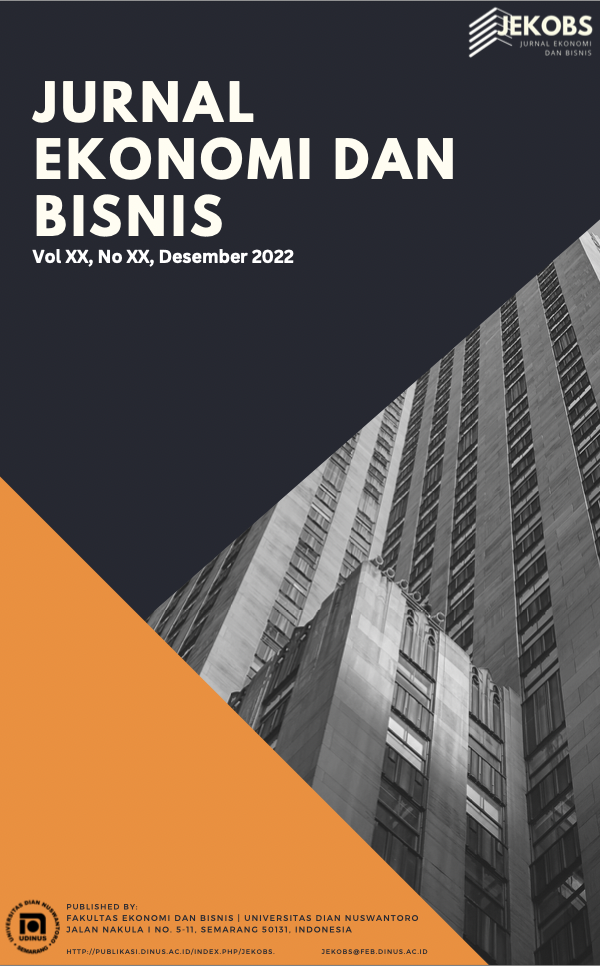
Journal Cover
English
Jurnal Ekonomi dan Bisnis (JEKOBS) is a peer-reviewed academic journal published by the Faculty of Economics and Business, Universitas Dian Nuswantoro. The journal serves as a primary platform for researchers, academics, and practitioners to disseminate original research and conceptual studies in the fields of economics, management, accounting, and Islamic economics.
JEKOBS is committed to maintaining high scientific standards through a rigorous double-blind peer-review process. The journal is published four times a year (March, June, September, and December). We provide immediate open access to our content to support the global exchange of knowledge. JEKOBS is currently indexed in Google Scholar, GARUDA, Dimensions, ICI World of Journals (Index Copernicus) and Neliti, with continuous efforts toward broader international indexing.
Bahasa Indonesia
Jurnal Ekonomi dan Bisnis (JEKOBS) adalah jurnal akademik yang diterbitkan oleh Fakultas Ekonomi dan Bisnis, Universitas Dian Nuswantoro. Jurnal ini berfungsi sebagai platform utama bagi para peneliti, akademisi, dan praktisi untuk menyebarluaskan penelitian asli dan studi konseptual di bidang ekonomi, manajemen, akuntansi, dan ekonomi Islam.
JEKOBS berkomitmen untuk menjaga standar ilmiah yang tinggi melalui proses double-blind peer-review yang ketat. Jurnal ini diterbitkan empat kali setahun (Maret, Juni, September, dan Desember). Kami menyediakan akses terbuka segera terhadap konten kami untuk mendukung pertukaran pengetahuan global. Saat ini, JEKOBS telah terindeks di Google Scholar, GARUDA, Dimensions, ICI World of Journals (Index Copernicus) and Neliti, dengan upaya berkelanjutan menuju pengindeksan internasional yang lebih luas.
Homepage http://publikasi.dinus.ac.id/index.php/JEKOBS
ISSN 2964-8866 (Online)
DOI Crossref 10.33633/jekobs
JEKOBS (Jurnal Ekonomi dan Bisnis), mulai Juni 2024, telah bermigrasi dari OJS 2 ke OJS 3. Pernyataan resmi mengenai migrasi dapat diakses DI SINI
Bagi penulis yang ingin mengakses OJS versi sebelumnya, dapat mengunjungi tautan arsip web lama JEKOBS
Jurnal Ekonomi dan Bisnis (JEKOBS) invites academics and researchers to submit original research in the fields of economics, management, and accounting, including but not limited to:
1. Management (Manajemen)
Marketing (Pemasaran)
Financial Management (Manajemen Keuangan)
Human Resource Management (Manajemen Sumber Daya Manusia)
Operations Management (Manajemen Operasional)
International Business (Bisnis Internasional)
Entrepreneurship (Kewirausahaan)
Digital Business & E-commerce (Bisnis Digital & E-commerce)
2. Economics (Ekonomi)
Monetary Economics, Finance, and Banking (Ekonomi Moneter, Keuangan, dan Perbankan)
International Economics (Ekonomi Internasional)
Public Economics (Ekonomi Publik)
Economic Development (Ekonomi Pembangunan)
Regional Economy (Ekonomi Regional)
Digital Economy (Ekonomi Digital)
3. Accounting (Akuntansi)
Taxation and Public Sector Accounting (Perpajakan dan Akuntansi Sektor Publik)
Accounting Information Systems (Sistem Informasi Akuntansi)
Auditing (Audit)
Financial Accounting (Akuntansi Keuangan)
Management Accounting (Akuntansi Manajemen)
Behavioral Accounting (Akuntansi Keperilakuan)
4. Islamic Economics (Ekonomi Islam)
Islamic Economics Science (Ilmu Ekonomi Islam)
Islamic Banking (Perbankan Syariah)
Islamic Public Finance (Keuangan Publik Islam)
Business & Halal Industry (Bisnis & Industri Halal)
Each submitted manuscript undergoes a double-blind peer review process. This means that the identities of the reviewers and authors are concealed from each other throughout the review process. The stages are as follows:
Initial Screening: The Editor-in-Chief/Editorial Board conducts a technical and administrative assessment to ensure the manuscript aligns with the journal's scope and guidelines.
Reviewer Assignment: Manuscripts that pass the initial screening are sent to at least two independent reviewers for blind review.
Reviewers' Evaluation: Reviewers evaluate the manuscript based on its originality, methodology, clarity, and contribution to the field.
Editorial Decision: Based on the reviewers' recommendations, the Editor will make one of the following decisions: Accepted, Required Revisions (Minor or Major), or Rejected.
Final Approval: Once the final revised version is approved by the Editor, the manuscript will proceed to the publication stage.
Review Timeline: The peer-review process typically takes 4 to 8 weeks from the initial submission. Authors will be notified of the editor's decision at each stage of the review process.
Setiap naskah yang masuk melalui proses double-blind peer review. Ini berarti identitas peninjau (reviewer) dan penulis disembunyikan satu sama lain selama proses peninjauan. Tahapannya adalah sebagai berikut:
Penyaringan Awal: Editor/Dewan Redaksi melakukan penilaian teknis dan administratif untuk memastikan naskah sesuai dengan ruang lingkup dan pedoman jurnal.
Penugasan Reviewer: Naskah yang lolos penyaringan awal dikirim ke setidaknya dua reviewer independen untuk ditinjau secara anonim.
Evaluasi Reviewer: Reviewer mengevaluasi naskah berdasarkan orisinalitas, metodologi, kejelasan, dan kontribusi terhadap bidang ilmu.
Keputusan Editorial: Berdasarkan rekomendasi reviewer, Editor akan mengambil salah satu keputusan berikut: Diterima (Accepted), Perbaikan (Minor atau Mayor), atau Ditolak (Rejected).
Persetujuan Akhir: Setelah versi revisi akhir disetujui oleh Editor, naskah akan diproses ke tahap publikasi.
Lini Masa Peninjauan: Proses peninjauan sejawat biasanya memakan waktu 4 hingga 8 minggu sejak pengiriman awal. Penulis akan diberitahu tentang keputusan editor pada setiap tahapan proses peninjauan.
Jurnal Ekonomi dan Bisnis (JEKOBS), with ISSN 2964-8866 (Online), is published quarterly in March, June, September, and December. The journal is accessible online through its official website at http://publikasi.dinus.ac.id/index.php/JEKOBS.
This journal provides immediate open access to its content, supporting the principle that making research freely available to the public fosters a greater global exchange of knowledge.
As an open-access journal, all content is freely available without charge to users or institutions. Users are permitted to read, download, copy, distribute, print, search, or link to the full text of articles in this journal, or use them for any other lawful purpose, without requiring prior permission from the publisher or author, provided the original authorship and source are properly acknowledged.
This journal adheres to the Creative Commons Attribution 4.0 International License (CC BY 4.0), which ensures that articles can be freely shared and adapted for any purpose, including commercial use, as long as proper attribution is given. This policy aligns with the principles of the Budapest Open Access Initiative.
Our Publication Ethics and Publication Malpractice Statement are based on COPEs Best Practice Guidelines for Journal Editors. As such, this journal follows the COPE Code of Conduct and Best Practice Guidelines for Journal Editors and the Code of Conduct for Journal Publishers.
A selection of key points is included below, but you should always refer to the three documents listed above for full details.
Duties of Editors
Fair play and editorial independence
Editors evaluate submitted manuscripts exclusively on the basis of their academic merit (importance, originality, studys validity, clarity) and its relevance to the journals scope, without regard to the authors race, gender, sexual orientation, ethnic origin, citizenship, religious belief, political philosophy or institutional affiliation. Decisions to edit and publish are not determined by the policies of governments or any other agencies outside of the journal itself. The Editor-in-Chief has full authority over the entire editorial content of the journal and the timing of publication of that content.
Confidentiality
Editors and editorial staff will not disclose any information about a submitted manuscript to anyone other than the corresponding author, reviewers, potential reviewers, other editorial advisers, and the publisher, as appropriate.
Disclosure and conflicts of interest
Editors and editorial board members will not use unpublished information disclosed in a submitted manuscript for their own research purposes without the authors explicit written consent. Privileged information or ideas obtained by editors as a result of handling the manuscript will be kept confidential and not used for their personal advantage. Editors will recuse themselves from considering manuscripts in which they have conflicts of interest resulting from competitive, collaborative, or other relationships/connections with any of the authors, companies or institutions connected to the papers; instead, they will ask another member of the editorial board to handle the manuscript.
Publication decisions
The editors ensure that all submitted manuscripts being considered for publication undergo peer-review by at least two reviewers who are expert in the field. The Editor-in-Chief is responsible for deciding which of the manuscripts submitted to the journal will be published, based on the validation of the work in question, its importance to researchers and readers, the reviewers comments, and such legal requirements as are currently in force regarding libel, copyright infringement and plagiarism. The Editor-in-Chief may confer with other editors or reviewers in making this decision.
Involvement and cooperation in investigations
Editors (in conjunction with the publisher and/or society) will take responsive measures when ethical concerns are raised with regard to a submitted manuscript or published paper. Every reported act of unethical publishing behaviour will be looked into, even if it is discovered years after publication. AP-SMART editors follow the COPE Flowcharts when dealing with cases of suspected misconduct. If, on investigation, the ethical concern is well-founded, a correction, retraction, expression of concern or other note as may be relevant, will be published in the journal.
Duties of Reviewers
Contribution to editorial decisions
Peer review assists editors in making editorial decisions and, through editorial communications with authors, may assist authors in improving their manuscripts. Peer review is an essential component of formal scholarly communication and lies at the heart of scientific endeavour. AP-SMART shares the view of many that all scholars who wish to contribute to the scientific process have an obligation to do a fair share of reviewing.
Promptness
Any invited referee who feels unqualified to review the research reported in a manuscript or knows that its prompt review will be impossible should immediately notify the editors and decline the invitation to review so that alternative reviewers can be contacted.
Confidentiality
Any manuscripts received for review are confidential documents and must be treated as such; they must not be shown to or discussed with others except if authorized by the Editor-in-Chief (who would only do so under exceptional and specific circumstances). This applies also to invited reviewers who decline the review invitation.
Standards of objectivity
Reviews should be conducted objectively and observations formulated clearly with supporting arguments so that authors can use them for improving the manuscript. Personal criticism of the authors is inappropriate.
Acknowledgement of sources
Reviewers should identify relevant published work that has not been cited by the authors. Any statement that is an observation, derivation or argument that has been reported in previous publications should be accompanied by the relevant citation. A reviewer should also notify the editors of any substantial similarity or overlap between the manuscript under consideration and any other manuscript (published or unpublished) of which they have personal knowledge.
Disclosure and conflicts of interest
Any invited referee who has conflicts of interest resulting from competitive, collaborative, or other relationships or connections with any of the authors, companies or institutions connected to the manuscript and the work described therein should immediately notify the editors to declare their conflicts of interest and decline the invitation to review so that alternative reviewers can be contacted.
Unpublished material disclosed in a submitted manuscript must not be used in a reviewers own research without the express written consent of the authors. Privileged information or ideas obtained through peer review must be kept confidential and not used for the reviewers personal advantage. This applies also to invited reviewers who decline the review invitation.
Duties of Authors
Reporting standards
Authors of original research should present an accurate account of the work performed and the results, followed by an objective discussion of the significance of the work. The manuscript should contain sufficient detail and references to permit others to replicate the work. Review articles should be accurate, objective and comprehensive, while editorial 'opinion' or perspective pieces should be clearly identified as such. Fraudulent or knowingly inaccurate statements constitute unethical behaviour and are unacceptable.
Data access and retention
Authors may be asked to provide the raw data of their study together with the manuscript for editorial review and should be prepared to make the data publicly available if practicable. In any event, authors should ensure accessibility of such data to other competent professionals for at least 10 years after publication (preferably via an institutional or subject-based data repository or other data centre), provided that the confidentiality of the participants can be protected and legal rights concerning proprietary data do not preclude their release.
Originality and plagiarism
Authors should ensure that they have written and submit only entirely original works, and if they have used the work and/or words of others, that this has been appropriately cited. Publications that have been influential in determining the nature of the work reported in the manuscript should also be cited. Plagiarism takes many forms, from "passing off" another's paper as the author's own, to copying or paraphrasing substantial parts of another's paper (without attribution), to claiming results from research conducted by others. Plagiarism in all its forms constitutes unethical publishing behaviour and is unacceptable.
Multiple, duplicate, redundant or concurrent submission/publication
Papers describing essentially the same research should not be published in more than one journal or primary publication. Hence, authors should not submit for consideration a manuscript that has already been published in another journal. Submission of a manuscript concurrently to more than one journal is unethical publishing behaviour and unacceptable.
The publication of some kinds of articles (such as clinical guidelines, translations) in more than one journal is sometimes justifiable, provided that certain conditions are met. The authors and editors of the journals concerned must agree to the secondary publication, which must reflect the same data and interpretation of the primary document. The primary reference must be cited in the secondary publication.
Authorship of the manuscript
Only persons who meet these authorship criteria should be listed as authors in the manuscript as they must be able to take public responsibility for the content: (i) made significant contributions to the conception, design, execution, data acquisition, or analysis/interpretation of the study; and (ii) drafted the manuscript or revised it critically for important intellectual content; and (iii) have seen and approved the final version of the paper and agreed to its submission for publication. All persons who made substantial contributions to the work reported in the manuscript (such as technical help, writing and editing assistance, general support) but who do not meet the criteria for authorship must not be listed as an author, but should be acknowledged in the "Acknowledgements" section after their written permission to be named as been obtained. The corresponding author should ensure that all appropriate coauthors (according to the above definition) and no inappropriate coauthors are included in the author list and verify that all coauthors have seen and approved the final version of the manuscript and agreed to its submission for publication.
Disclosure and conflicts of interest
Authors should—at the earliest stage possible (generally by submitting a disclosure form at the time of submission and including a statement in the manuscript)—disclose any conflicts of interest that might be construed to influence the results or their interpretation in the manuscript. Examples of potential conflicts of interest that should be disclosed include financial ones such as honoraria, educational grants or other funding, participation in speakers bureaus, membership, employment, consultancies, stock ownership, or other equity interest, and paid expert testimony or patent-licensing arrangements, as well as non-financial ones such as personal or professional relationships, affiliations, knowledge or beliefs in the subject matter or materials discussed in the manuscript. All sources of financial support for the work should be disclosed (including the grant number or other reference number if any).
Acknowledgement of sources
Authors should ensure that they have properly acknowledged the work of others, and should also cite publications that have been influential in determining the nature of the reported work. Information obtained privately (from conversation, correspondence or discussion with third parties) must not be used or reported without explicit, written permission from the source. Authors should not use information obtained in the course of providing confidential services, such as refereeing manuscripts or grant applications, unless they have obtained the explicit written permission of the author(s) of the work involved in these services.
Hazards and human or animal subjects
If the work involves chemicals, procedures or equipment that have any unusual hazards inherent in their use, the authors must clearly identify these in the manuscript. If the work involves the use of animals or human participants, the authors should ensure that all procedures were performed in compliance with relevant laws and institutional guidelines and that the appropriate institutional committee(s) has approved them; the manuscript should contain a statement to this effect. Authors should also include a statement in the manuscript that informed consent was obtained for experimentation with human participants. The privacy rights of human participants must always be observed.
Peer review
Authors are obliged to participate in the peer review process and cooperate fully by responding promptly to editors requests for raw data, clarifications, and proof of ethics approval, patient consents and copyright permissions. In the case of a first decision of "revisions necessary", authors should respond to the reviewers comments systematically, point by point, and in a timely manner, revising and re-submitting their manuscript to the journal by the deadline given.
Fundamental errors in published works
When authors discover significant errors or inaccuracies in their own published work, it is their obligation to promptly notify the journals editors or publisher and cooperate with them to either correct the paper in the form of an erratum or to retract the paper. If the editors or publisher learns from a third party that a published work contains a significant error or inaccuracy, then it is the authors obligation to promptly correct or retract the paper or provide evidence to the journal editors of the correctness of the paper.
Duties of the Publisher
Handling of unethical publishing behaviour
In cases of alleged or proven scientific misconduct, fraudulent publication or plagiarism, the publisher, in close collaboration with the editors, will take all appropriate measures to clarify the situation and to amend the article in question. This includes the prompt publication of an erratum, clarification or, in the most severe case, the retraction of the affected work. The publisher, together with the editors, shall take reasonable steps to identify and prevent the publication of papers where research misconduct has occurred, and under no circumstances encourage such misconduct or knowingly allow such misconduct to take place.
Access to journal content
The publisher is committed to the permanent availability and preservation of scholarly research and ensures accessibility by partnering with organizations and maintaining our own digital archive.
Section A: Publication and authorship
Section B: Authors’ responsibilities
Section C: Reviewers’ responsibilities
Section D: Editors’ responsibilities
Sources:
Author Fees (English) This journal charges the following author fees:
Article Submission: 0.00 (IDR) - Free of charge.
Article Processing (APC): 0.00 (IDR) - Free of charge.
Article Access: 0.00 (IDR) - Free of charge (Open Access).
Biaya Penulis (Bahasa Indonesia) Jurnal ini membebankan biaya penulis sebagai berikut:
Penyerahan Artikel: 0,00 (IDR) - Gratis.
Pemrosesan Artikel (APC): 0,00 (IDR) - Gratis.
Akses Artikel: 0,00 (IDR) - Gratis (Akses Terbuka).
Policy of Screening for Plagiarism (English)
All manuscripts submitted to Jurnal Ekonomi dan Bisnis (JEKOBS) must be free from plagiarism. To ensure this, every article undergoes a mandatory plagiarism check before the review process and before publication.
Detection Tool: The journal uses Turnitin to check for similarities.
Threshold: The maximum acceptable similarity index is 25%.
Action: Manuscripts with a similarity index higher than 25% will be returned to the author for revision or may be rejected if significant plagiarism is detected.
Kebijakan Pemeriksaan Plagiarisme (Bahasa Indonesia)
Semua naskah yang dikirimkan ke Jurnal Ekonomi dan Bisnis (JEKOBS) harus bebas dari plagiarisme. Untuk memastikan hal ini, setiap artikel wajib menjalani pemeriksaan plagiarisme sebelum proses peninjauan dan sebelum publikasi.
Alat Deteksi: Jurnal menggunakan Turnitin untuk memeriksa tingkat kemiripan.
Ambang Batas: Indeks kemiripan maksimal yang dapat diterima adalah 25%.
Tindakan: Naskah dengan indeks kemiripan lebih tinggi dari 25% akan dikembalikan kepada penulis untuk direvisi atau dapat ditolak jika ditemukan plagiarisme yang signifikan.
English
JEKOBS is currently indexed in Google Scholar, GARUDA, Dimensions, ICI World of Journals (Index Copernicus) and Neliti, with continuous efforts toward broader international indexing.
Bahasa Indonesia
Saat ini, JEKOBS telah terindeks di Google Scholar, GARUDA, Dimensions, ICI World of Journals (Index Copernicus) and Neliti, dengan upaya berkelanjutan menuju pengindeksan internasional yang lebih luas.
Jurnal Ekonomi dan Bisnis (JEKOBS) adalah jurnal akademik yang diterbitkan secara berkala bagi studi bidang ekonomi dan bisnis, dengan tujuan untuk menyediakan platform publikasi bagi penelitian empiris dan konseptual dalam bidang ekonomi dan bisnis. Jurnal ini menerima artikel dari peneliti dengan berbagai jenjang pendidikan, mulai dari sarjana, master, hingga pascasarjana, yang bertujuan untuk menyebarkan temuan-temuan ilmiah yang relevan dengan perkembangan terkini dalam bidang ekonomi dan bisnis.
Setiap artikel yang dipublikasikan di JEKOBS telah melalui proses peer review yang ketat, di mana artikel akan dievaluasi oleh reviewer yang memiliki keahlian dalam bidang yang sesuai dengan topik penelitian. Proses ini memastikan bahwa setiap publikasi yang diterbitkan memenuhi standar ilmiah yang tinggi dan memiliki kontribusi yang signifikan terhadap perkembangan ilmu pengetahuan.
Jurnal Ekonomi dan Bisnis (JEKOBS) diterbitkan secara berkala setiap tiga bulan, yaitu pada bulan Maret, Juni, September, dan Desember. Publikasi dilakukan secara online, dan seluruh artikel dapat diakses secara terbuka melalui platform digital OJS di:
Homepage http://publikasi.dinus.ac.id/index.php/JEKOBS
ISSN 2964-8866 (Online)
DOI Crossref 10.33633/jekobs
JEKOBS (Jurnal Ekonomi dan Bisnis), mulai Juni 2024, telah bermigrasi dari OJS 2 ke OJS 3. Pernyataan resmi mengenai migrasi dapat diakses DI SINI
Bagi penulis yang ingin mengakses OJS versi sebelumnya, dapat mengunjungi tautan arsip web lama JEKOBS
Jurnal Ekonomi dan Bisnis (JEKOBS)
Published by:
Fakultas Ekonomi dan Bisnis | Universitas Dian Nuswantoro
Jalan Nakula I No. 5-11, Semarang, Jawa Tengah 50131, Indonesia
Email: jekobs@feb.dinus.ac.id
Phone: (024) 3567010
Website: https://publikasi.dinus.ac.id/index.php/JEKOBS
ISSN
2964-8866 (Online)

This work is licensed under a Creative Commons Attribution 4.0 International License (CC BY 4.0)
