
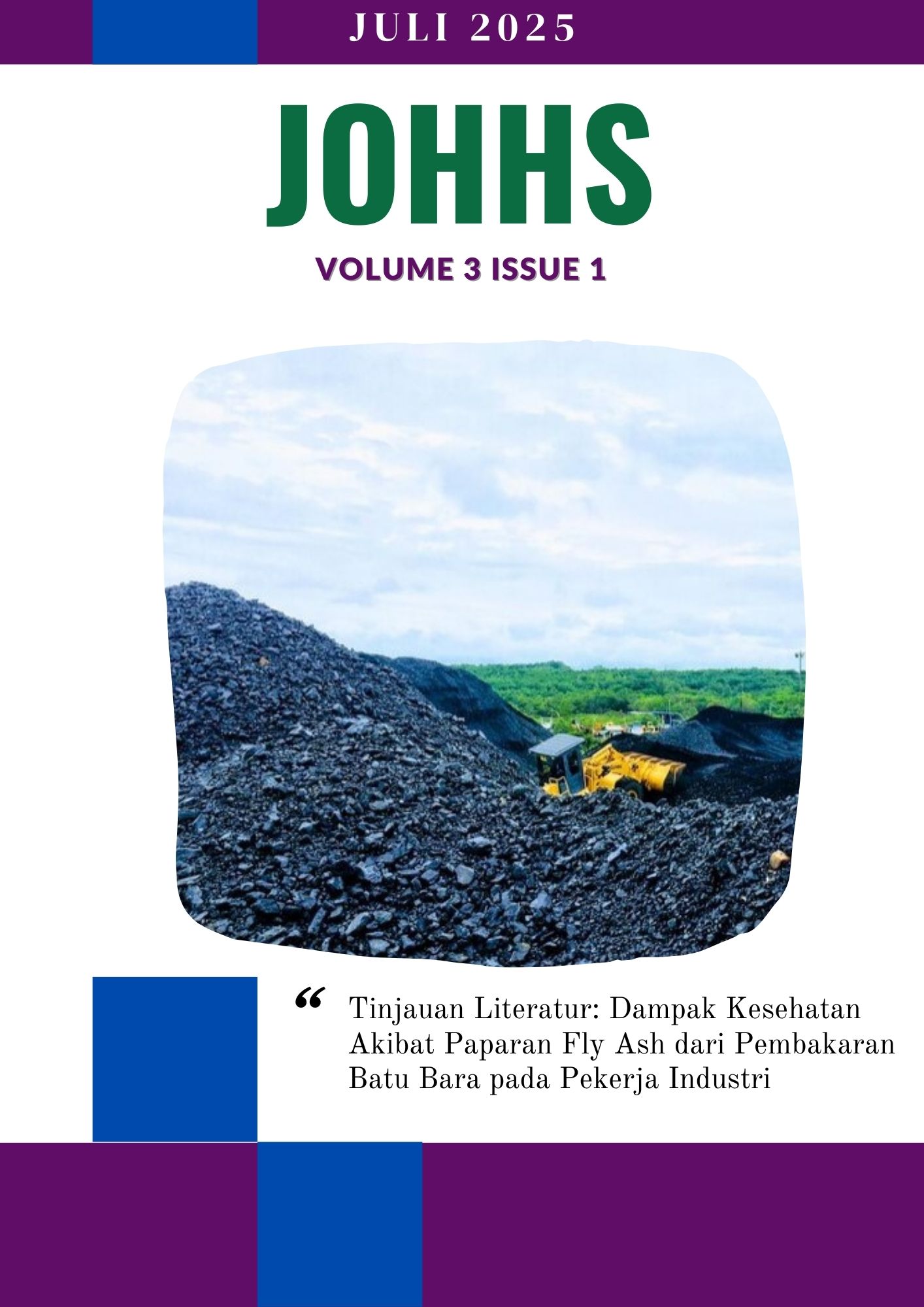
Tinjauan Literatur: Dampak Kesehatan Akibat Paparan Fly Ash dari Pembakaran Batu Bara pada Pekerja Industri
DOI:
https://doi.org/10.60074/johhs.v3i1.12654Keywords:
Industry workers, health risk, coal fly ash exposureAbstract
Over the past three decades, global coal consumption has increased significantly. Indonesia has become one of the largest consumers in the ASEAN region. One of the primary by-products of coal combustion is fly ash, a fine particulate material that contains various heavy metals such as lead, arsenic, chromium, and cadmium. Although the concentrations are relatively low, long-term exposure to fly ash poses serious health risks. This study aims to examine the health impacts of fly ash exposure on industrial workers, particularly those working in coal-fired industry. The method used is a narrative literature review by analyzing articles from databases such as Google Scholar, PubMed, and ScienceDirect, published between 2015 and 2025. The results show that fly ash exposure can lead to various health issues, including contact dermatitis, elevated blood lead levels, DNA damage, hemolysis, and apoptosis of bronchial cells. The severity of these impacts is influenced by particle size, chemical composition, duration of exposure, and the use of personal protective equipment (PPE). Therefore, further research and stricter occupational safety policies are needed to protect the health of industrial workers.References
International Energy Agency (IEA), 2024. Coal 2024: Analysis and forecast to 2027. [online] Paris: IEA. Available at: https://www.iea.org/reports/coal-2024 [Accessed 22 Apr. 2025].
Chen, Y., Fan, Y., Huang, Y., Liao, X., Xu, W., and Zhang, T., 2024. A comprehensive review of toxicity of coal fly ash and its leachate in the ecosystem. Ecotoxicology and Environmental Safety, 269. https://doi.org/10.1016/j.ecoenv.2023.115905.
Kementerian Lingkungan Hidup dan Kehutanan, 2021. Keputusan Menteri LHK Nomor 14 Tahun 2021 tentang Baku Mutu Emisi Usaha dan/atau Kegiatan Pembangkit Listrik Termal. Jakarta: KLHK.
Zierold, K.M. and Odoh, C., 2020. A review on fly ash from coal-fired power plants: chemical composition, regulations, and health evidence. Reviews on Environmental Health, 35(4), pp.401–418. https://doi.org/10.1515/reveh-2019-0039.
Kementerian Ketenagakerjaan, 2018. Peraturan Menteri Ketenagakerjaan Republik Indonesia Nomor 5 Tahun 2018 tentang Keselamatan dan Kesehatan Lingkungan Kerja. Jakarta: Kementerian Ketenagakerjaan RI.
Whiteside, M. and Herndon, J.M., 2018. Coal fly ash aerosol: risk factor for lung cancer. Journal of Advances in Medicine and Medical Research, 25(4), pp.1–10. https://doi.org/10.9734/JAMMR/2018/39758.
Apriyantri, A.P., 2015. Pengaruh abu terbang batubara terhadap timbulnya gejala dermatitis kontak pada karyawan bagian boiler di PT. Indo Acidatama Tbk, Kemiri, Kebakkramat, Karanganyar (Skripsi). Universitas Muhammadiyah Surakarta, Surakarta.
Damasceno, K.C., Cavalcante, A.K., Maziero, J.S., Martini, G.A., Ormênio, M.B., Mamede, F.C., Miranda, C.S., Campello, F.A., Izidoro, J.C., Rogero, S.O., Fungaro, D.A., Lopes-Ferreira, M. and Rogero, J.R., 2018. In vitro and in vivo toxicity of coal fly ash leachate. Ecotoxicology and Environmental Contamination, 13(1), pp.73–78. https://doi.org/10.5132/eec.2018.01.08.
Ayuningtyas, U., Susila, I.M.A.D., Sihombing, A.L.S.M., Sasongko, N.A., Anggraeni, P., Nugroho, T.P.A. and Darmayanti, N.T.E., 2022. Pemanfaatan fly ash dan bottom ash sebagai material konstruksi ramah lingkungan dalam rangka mendukung kriteria bangunan hijau. Seminar Nasional Penelitian dan Pengabdian kepada Masyarakat 2022, Pangkalpinang, 11–12 Oktober 2022. Fakultas Teknik, Universitas Bangka Belitung.
Nurcahyani, H., 2023. Penelitian strategi pengembangan koleksi di perpustakaan pada Google Scholar: sebuah narrative literature review. Jurnal Pustaka Budaya, 10(1), pp.32–43.
Tasidjawa, G.E., Nurkhamim and Firmansyah, A., 2022. Overview risiko dampak debu akibat aktivitas penambangan di Indonesia. Prosiding Nasional Rekayasa Teknologi Industri dan Informasi XVII (ReTII), November 2022, pp.312–317.
Izzawati, 2024. Hubungan kadar timbal darah dengan kadar hemoglobin karyawan pembangkit listrik tenaga uap. Journal of Nursing and Health (JNH), 9(3), pp.341–347.
Lawson, M.J., Prytherch, Z.C., Jones, T.P., Adams, R.A. and BéruBé, K.A., 2020. Iron-rich magnetic coal fly ash particles induce apoptosis in human bronchial cells. Applied Sciences, 10(23), p.8368. https://doi.org/10.3390/app10238368.
Rozhina, E., Ishmukhametov, I., Nigamatzyanova, L., Akhatova, F., Batasheva, S., Taskaev, S., Montes, C., Lvov, Y. and Fakhrullin, R., 2021. Comparative toxicity of fly ash: an in vitro study. Molecules, 26, p.1926. https://doi.org/10.3390/molecules26071926.
Jumpponen, M., 2017. Occupational exposure to components of biomass-fired power plant ash (Disertasi). Publications of the University of Eastern Finland. Dissertations in Forestry and Natural Sciences, No. 285. Kuopio: University of Eastern Finland.
Agency for Toxic Substances and Disease Registry (ATSDR), 2023. Physiological effects of lead. [online] Available at: https://archive.cdc.gov/www_atsdr_cdc_gov/csem/leadtoxicity/physiological_effects.html [Accessed 24 Apr. 2025].
León-Mejía, G., Machado, M.N., Okuro, R.T., Silva, L.F.O., Telles, C., Dias, J., Niekraszewicz, L., Da Silva, J., Henriques, J.A.P. and Zin, W.A., 2018. Intratracheal instillation of coal and coal fly ash particles in mice induces DNA damage and translocation of metals to extrapulmonary tissues. Science of the Total Environment, 625, pp.589–599. https://doi.org/10.1016/j.scitotenv.2017.12.283.
Downloads
Published
Issue
Section
License
Copyright (c) 2025 Rina Widya Astuti, Izzatul Alifah Sifai

This work is licensed under a Creative Commons Attribution-NonCommercial-ShareAlike 4.0 International License.
The authors retain the copyright of this work and grant Journal of Occupational Health, Hygiene and Safety (JOHHS) the right of first publication. The work is simultaneously licensed under a Creative Commons Attribution-NonCommercial-ShareAlike 4.0 International License (CC BY-NC-SA 4.0), which permits use, distribution, and reproduction in any medium for non-commercial purposes, provided the original author(s) and the initial publication in this journal are properly credited, and any derivative works are distributed under the same license.
The authors are permitted to copy and redistribute the published version of the work, including posting it to an institutional repository or including it in a book, with acknowledgment of its initial publication in Journal of Occupational Health, Hygiene and Safety (JOHHS).