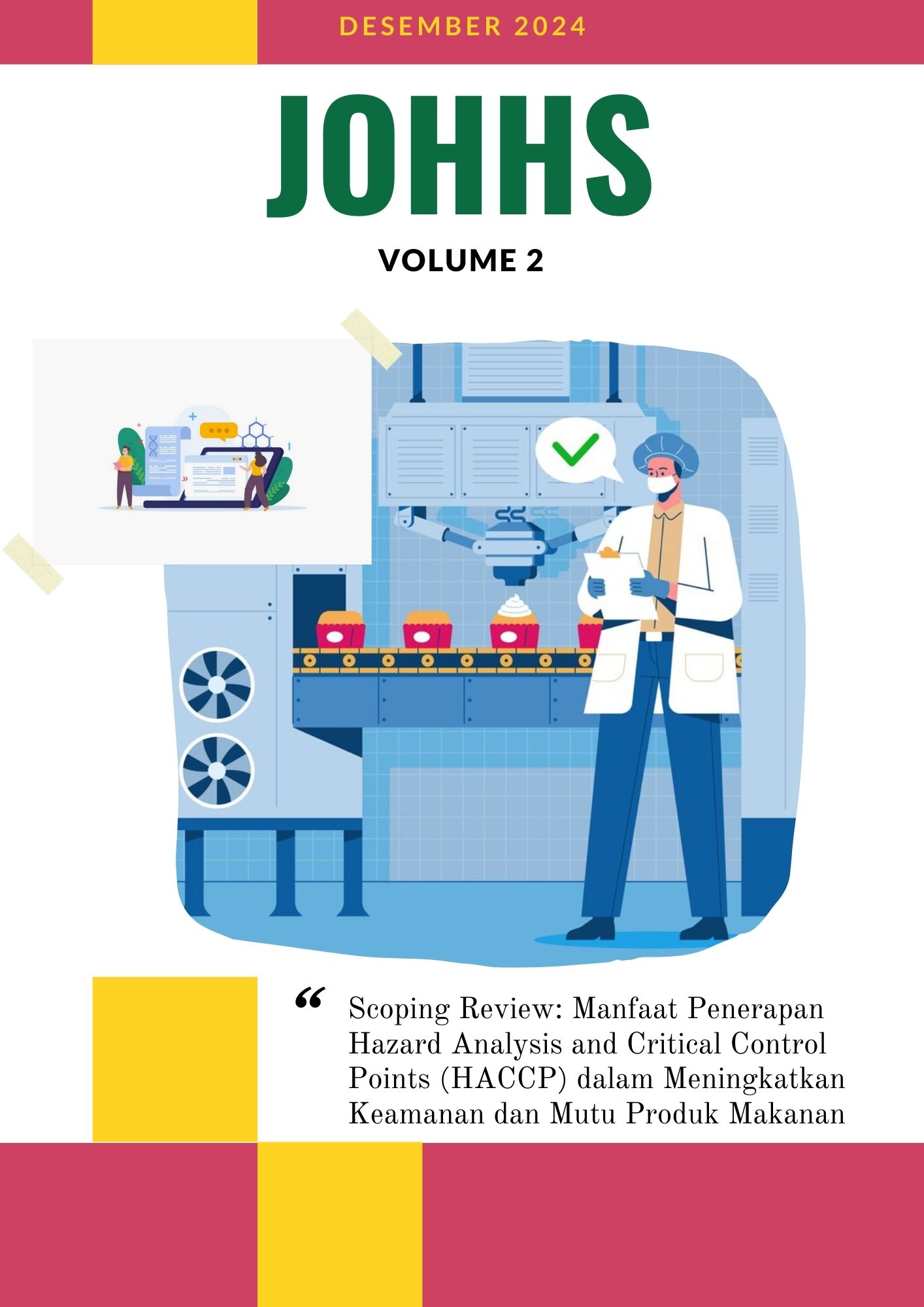
Scoping Review: Manfaat Penerapan Hazard Analysis and Critical Control Points (HACCP) dalam Meningkatkan Keamanan dan Mutu Produk Makanan
DOI:
https://doi.org/10.60074/johhs.v2i2.11348Keywords:
HACCP, Food Safety, Food HygieneAbstract
HACCP (Hazard Analysis and Critical Control Points) merupakan system manajemen keamanan pangan yang melindungi konsumen dari risiko atau penyakit yang berhubungan dengan bawaan pangan serta memiliki dampak yang signifikan terhadap kesehatan masyarakat pada industri pangan. Sistem HACCP memastikan bahwa produk pangan aman untuk dikonsumsi dengan melakukan identifikasi dan pengelolaan potensi bahwa pada setiap tahap proses produksi. Tujuan dari artikel ini adalah memberikan gambaran yang komprehensif tentang bagaimana HACCP dapat digunakan untuk meningkatkan keamanan dan mutu produk makanan, serta memberikan saran untuk perbaikan dalam implementasi sistem HACCP. Metode yang digunakan adalah teknik scoping literature review dengan mendapatkan data pencarian dari PubMed dan Science Direct dengan kriteria inklusi jurnal telah terpublikasu dalam kurun waktu 5 tahun (2020 – 2024). Berdasarkan analisis 5 artikel didapatkan hasil penerapan Hazard Analysis and Critical Control Points (HACCP) memiliki dampak yang positif dan signifikan dalam meningkatkan keamanan dan mutu produk makanan. Pada penelitian ini penerapan HACCP dapat mengurangi kontaminasi pada proses produksi dan mengurangi kasus keracunan makanan. Pada tinjauan scoping literature review ini, terdapat beberapa keterbatasan dalam penelitianannya, yaitu lima artikel jurnal yang digunakan memiliki desain dan konteks yang berbeda-beda. Oleh karena itu, hasil penelitian tidak dapat diterapkan secara menyeluruh dan konsisten dalam berbagai situasi. Selain itu, penelitian ini hanya fokus pada wilayah dan sektor tertentu, sehingga mungkin tidak memperhatikan tren masalah dan tantangan yang lebih luas di bidang manajemen keamanan pangan. Namun, penerapan HACCP sangat penting untuk meningkatkan keamanan pangan dan melindungi masyarakat dari penyakit bawaan pangan.References
E. Todd, “Food-borne disease prevention and risk assessmentTodd, E. (2020). Food-borne disease prevention and risk assessment. International Journal of Environmental Research and Public Health, 17(14), 1–13. https://doi.org/10.3390/ijerph17145129,” Int. J. Environ. Res. Public Health, vol. 17, no. 14, pp. 1–13, 2020.
M. D. Kirk et al., “World Health Organization Estimates of the Global and Regional Disease Burden of 22 Foodborne Bacterial, Protozoal, and Viral Diseases, 2010: A Data Synthesis,” PLoS Med., vol. 12, no. 12, pp. 1–21, 2015, doi: 10.1371/journal.pmed.1001921.
G. M. Tebbutt, “Does microbiological testing of foods and the food environment have a role in the control of foodborne disease in England and Wales?,” J. Appl. Microbiol., vol. 102, no. 4, pp. 883–891, 2007, doi: 10.1111/j.1365-2672.2007.03311.x.
T. A. McMeekin and T. Ross, “Predictive microbiology: Providing a knowledge-based framework for change management,” Int. J. Food Microbiol., vol. 78, no. 1–2, pp. 133–153, 2002, doi: 10.1016/S0168-1605(02)00231-3.
I. Trisnaini, “Analisis Bahaya Titik Kendali Kritis Proses Pengolahan Bola-Bola Daging di Instalasi Gizi Rumah Sakit,” Kesmas Natl. Public Heal. J., vol. 7, no. 3, p. 131, 2012, doi: 10.21109/kesmas.v7i3.60.
H. Mehlhorn, “Food-Borne Disease Burden Epidemiology Reference Group,” Encycl. Parasitol., pp. 1068–1069, 2016, doi: 10.1007/978-3-662-43978-4_3884.
B. Ergönül, “Consumer awareness and perception to food safety: A consumer analysis,” Food Control, vol. 32, no. 2, pp. 461–471, 2013, doi: 10.1016/j.foodcont.2013.01.018.
K. D. Arisandi, T. Trianasari, and P. G. Parma, “Implementasi Hazard Analysis and Critical Control Point (HACCP) dalam Penyimpanan Bahan Baku Makanan di Hotel Discovery Kartika Plaza Hotel,” J. Manaj. Perhotelan dan Pariwisata, vol. 2, no. 1, p. 55, 2019, doi: 10.23887/jmpp.v2i1.22089.
S. Cusato, P. Tavolaro, and C. Oliveira, “Implementation of Hazard Analysis and Critical Control Points System in the Food Industry: Impact on Safety and the Environment,” Nov. Technol. Food Sci. Their Impact Prod. Consum. Trends Environ., no. October 2012, pp. 1–421, 2012, doi: 10.1007/978-1-4419-7880-6.
I. M. Ferris, “Hazard analysis and critical control points (HACCP),” Appl. food Sci., pp. 187–213, 2022, doi: 10.3920/978-90-8686-933-6.
[11] P. D. Kilmer, “Review Article: Review Article,” Journalism, vol. 11, no. 3, pp. 369–373, 2010, doi: 10.1177/1461444810365020.
J. Peterson, P. F. Pearce, L. A. Ferguson, and C. A. Langford, “Understanding scoping reviews: Definition, purpose, and process,” J. Am. Assoc. Nurse Pract., vol. 29, no. 1, pp. 12–16, 2017, doi: 10.1002/2327-6924.12380.
S. B. Jeffer, I. I. Kassem, S. A. Kharroubi, and G. K. Abebe, “Analysis of food safety management systems in the beef meat processing and distribution chain in Uganda,” Foods, vol. 10, no. 10, pp. 1–12, 2021, doi: 10.3390/foods10102244.
A. Siddiky, K. Mollick, M. Aktarujjaman, F. Islam, M. A. Mamun, and N. Roy, “Determinants of food safety knowledge and practices among food handlers in Bangladesh: An institution-based cross-sectional study,” Heliyon, vol. 10, no. 4, p. e25970, 2024, doi: 10.1016/j.heliyon.2024.e25970.
M. Guennouni et al., “Knowledge and Practices of Food Safety among Health Care Professionals and Handlers Working in the Kitchen of a Moroccan University Hospital,” J. Food Prot., vol. 85, no. 4, pp. 676–685, 2022, doi: 10.4315/JFP-21-305.
M. Kim, C. Barnett-Neefs, R. A. Chavez, E. Kealey, M. Wiedmann, and M. J. Stasiewicz, “Risk Assessment Predicts Most of the Salmonellosis Risk in Raw Chicken Parts is Concentrated in Those Few Products with High Levels of High-Virulence Serotypes of Salmonella,” J. Food Prot., vol. 87, no. 7, p. 100304, 2024, doi: 10.1016/j.jfp.2024.100304.
E. Radu et al., “Global trends and research hotspots on HACCP and modern quality management systems in the food industry,” Heliyon, vol. 9, no. 7, 2023, doi: 10.1016/j.heliyon.2023.e18232.
R. Rifqie Mariana, L. Hidayati, and S. Soekopitojo, “Implementing the HACCP system to the production of Bakso Malang-Indonesia,” J. Culin. Sci. Technol., vol. 17, no. 4, pp. 291–312, 2019, doi: 10.1080/15428052.2018.1442760.
W. Mansour et al., “Management of human resources for health in health districts in Uganda: A decision space analysis,” Int. J. Health Plann. Manage., vol. 37, no. 2, pp. 770–789, 2022, doi: 10.1002/hpm.3359.
A. Ayelign, T. Alemu, and S. De Saeger, “Validation of a HACCP community-based infants’ complementary food safety assurance method in cash crop producing communities in Gedeo zone, Southern Ethiopia,” Food Addit. Contam. - Part A, vol. 39, no. 7, pp. 1311–1320, 2022, doi: 10.1080/19440049.2022.2075040.
M.-K. S. Sulfath Hakkim Hazeena, Xiao-Han Chen, Chia-Sheng Yeh, Chang-Wei Hsieh, Min-Hung Chen, Ping-Hsiu Huang, Chih-Yao Hou, “The relationship among knowledge, attitude, and behavior of workers on food safety in Taiwan’s Company A,” J. Food Sci. Technol., vol. 60, no. 4, pp. 1294–1302, 2023.
S. Wang, “Evaluation of HACCP Implementation within Food Industry in China,” in Evaluation of HACCP Implementation within Food Industry in China, 2021. [Online]. Available: https://api.semanticscholar.org/CorpusID:244967166
A. Allam, N. Shafik, A. Zayed, I. Khalifa, I. A. Bakry, and M. A. Farag, “Plain set and stirred yogurt with different additives: implementation of food safety system as quality checkpoints,” PeerJ, vol. 11, pp. 1–21, 2023, doi: 10.7717/peerj.14648.
M. Allam et al., “Assistance Needed for Increasing Knowledge of HACCP Food Safety Principles for Organic Sector in Selected EU Countries,” Sustain., vol. 15, no. 8, pp. 1–21, 2023, doi: 10.3390/su15086605.
Downloads
Published
Issue
Section
License
Copyright (c) 2024 Sita Dewi Mulyawati

This work is licensed under a Creative Commons Attribution-NonCommercial-ShareAlike 4.0 International License.
The authors retain the copyright of this work and grant Journal of Occupational Health, Hygiene and Safety (JOHHS) the right of first publication. The work is simultaneously licensed under a Creative Commons Attribution-NonCommercial-ShareAlike 4.0 International License (CC BY-NC-SA 4.0), which permits use, distribution, and reproduction in any medium for non-commercial purposes, provided the original author(s) and the initial publication in this journal are properly credited, and any derivative works are distributed under the same license.
The authors are permitted to copy and redistribute the published version of the work, including posting it to an institutional repository or including it in a book, with acknowledgment of its initial publication in Journal of Occupational Health, Hygiene and Safety (JOHHS).