Examining Hate Speech and Social Media in Indonesia: A Systematic Literature Review
DOI:
https://doi.org/10.33633/ja.v9i2.17621Abstract
Hate speech and social media are increasingly prominent topics for scholars in Indonesia, yet prior reviews on the subject tend to remain within a single discipline. Building on the digital boom triggered by the Covid-19 pandemic, we systematically mapped the thematic trends of hate speech and social media research in Indonesia published between 2020 and 2025. We queried our corpus from ScienceDirect and utilised R, RStudio, and the Bibliometrix package as the primary tools to analyse the corpus. Our findings show that this remains a rapidly growing field (CAGR of 45.4% per year), with hate speech and offensive content detection forming its conceptual core, and deep learning and language models. Dominant methods cover deep learning and language models such as BERT and its Indonesian derivative. The thematic evolution shifted from situational triggers of Covid-19 pandemics to long-term structural issues such as hate speech itself and disinformation. Interpreting these patterns through Computer-Mediated Communication (CMC) and the Social Identity model of Deindividuation Effects (SIDE) as primary lenses, with Social Identity Theory (SIT) as a secondary lens, we argue that platform affordances and anonymity intensify group-based hostility in ways the literature has yet to explicitly theorise, particularly within Indonesia's distinct religious and linguistic context.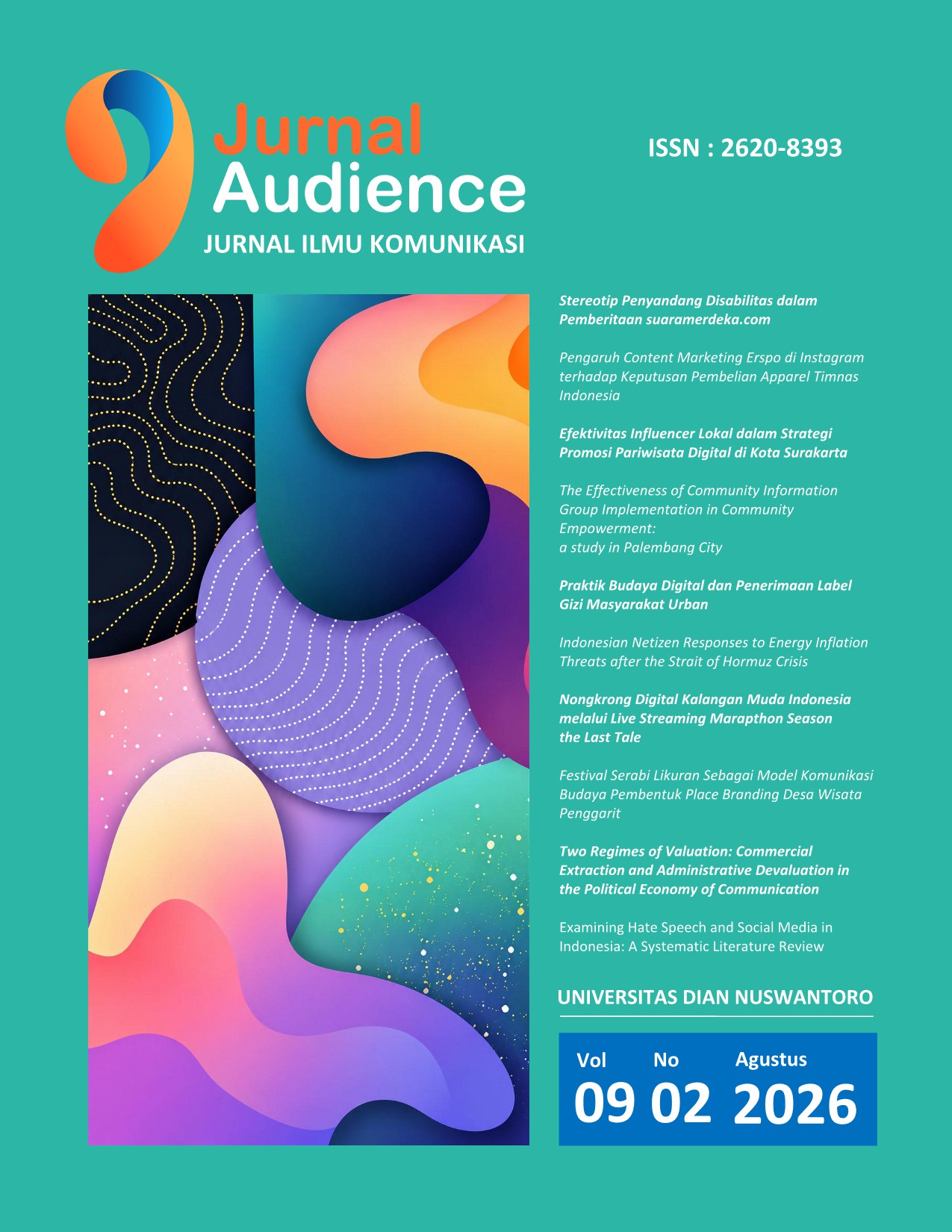
Downloads
Published
2026-09-01
Issue
Section
Articles
License
Authors who publish with this journal agree to the following terms:
- Authors retain copyright and grant the journal right of first publication with the work simultaneously licensed under a Creative Commons Attribution License that allows others to share the work with an acknowledgment of the work's authorship and initial publication in this journal.
- Authors are able to enter into separate, additional contractual arrangements for the non-exclusive distribution of the journal's published version of the work (e.g., post it to an institutional repository or publish it in a book), with an acknowledgment of its initial publication in this journal.
- Authors are permitted and encouraged to post their work online (e.g., in institutional repositories or on their website) prior to and during the submission process, as it can lead to productive exchanges, as well as earlier and greater citation of published work (See The Effect of Open Access).