
Factors Influencing Cesarean Section (CS) Deliveries In Indonesia (DHS Program Analysis)
DOI:
https://doi.org/10.60074/visikes.v25i1.14983Keywords:
Caesarean section, DHS data, maternal age, wealth index, breech position, prolonged laborAbstract
There are numerous potential issues that might arise during birth, leading to morbidity and even death for both mothers and fetuses. Indonesia's 2020 Maternal Mortality Rate (MMR) was 189 fatalities for every 100,000 live births. Cesarean section (CS) is one maternal care intervention that has a strong correlation with maternal and fetal morbidity and mortality. The DHS Program particularly for Indonesia, also known as the SDKI (Indonesian Demographic Health Survey), provided the secondary data used in this study. Data on 17,746 respondents was gathered after controlling for the inclusion and exclusion criteria.frequency tests were utilized for univariate analysis, and Pearson Product Moment tests were used for bivariate analysis. 2,915 mother's had cesarean section deliveries; the majority of these mothers were between the ages of 30 and 34 and came from extremely low-income backgrounds. 2,117 births included prolonged labor and 1,331 were breech presentation. Cesarean section delivery can be influenced by the mother's age (p-value 0,001), wealth index (p-value 0,001), breech position (p-value 0,001) and prolonged labor (p-value 0,001). Among these four variables, the one with the strongest correlation is the wealth index (pearson correlation 0,244).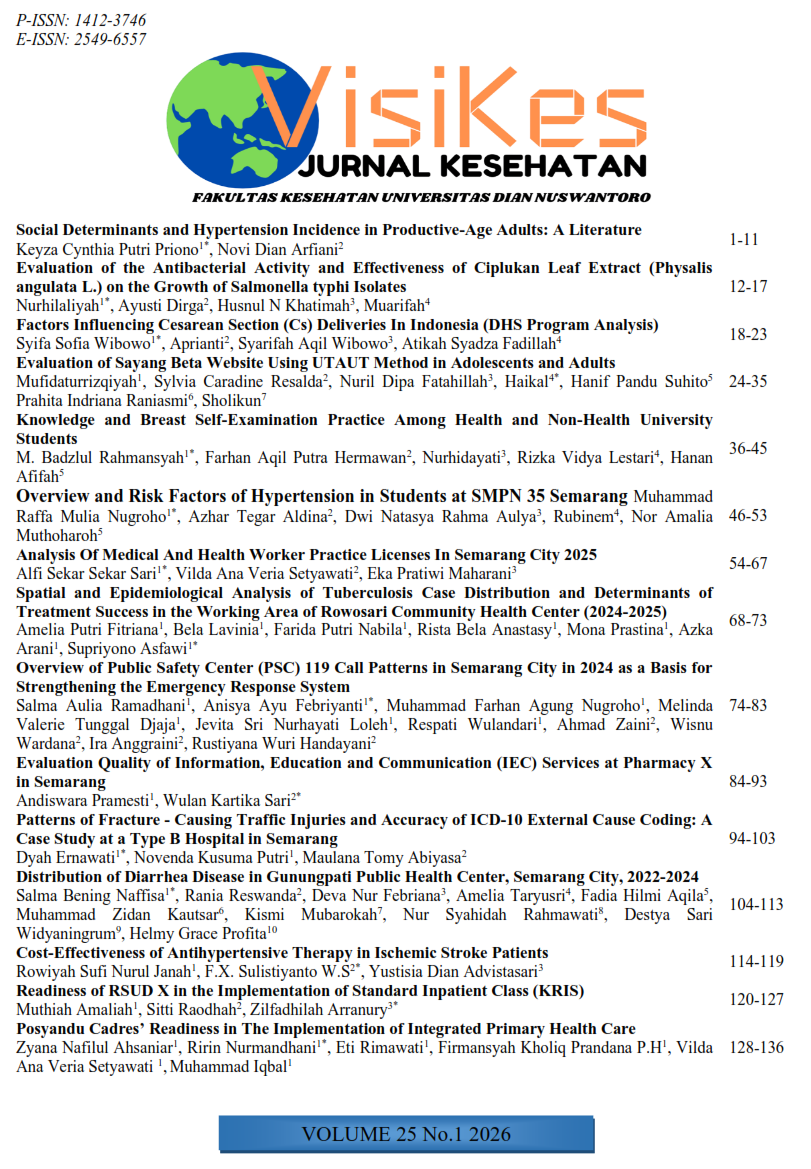
Downloads
Published
2026-04-30
Issue
Section
Articles
License

This work is licensed under a Creative Commons Attribution-NonCommercial 4.0 International License.